A shallow pool with bat rays is another encounter.

Baron was a little unsure of the concept, but the small crowds of small people showed him the way. He was perfectly willing to place his hands in the shark tank. These are banded bamboo sharks, sharks nonetheless.
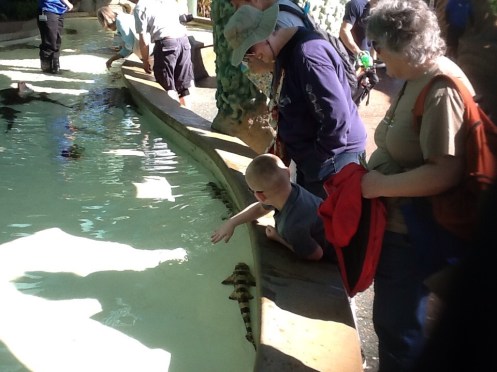
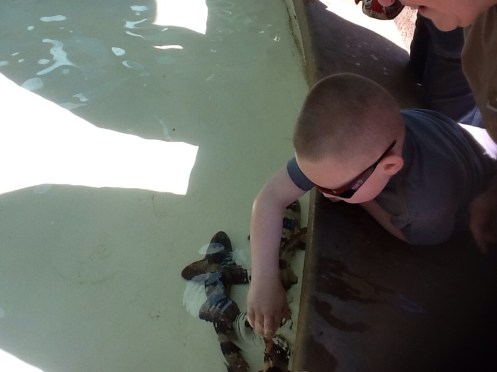
Have you seen Blackfish? Has the movie turned you off from ever visiting any of the SeaWorld sites? Then read no further, because we had a good time.
We had to roust the kid out a little after seven in order to get dressed, breakfasted, and on the road by nine. Drove down in rush hours to SeaWorld to meet Paula’s sister Nancy at the gate at ten. Six to seven lanes of traffic on the freeways, with motorcycles zooming by at high speeds between the lanes. Saw one motorcycle, with driver standing guard, laid over and damaged from some encounter with a car. The wages of speed and driving in tight quarters.
Paula had recent foot surgery, and has been cautioned against excessive walking, and been provided with a accessibility hanger that we took along. So we get to park right up close to the gate. Nancy is waiting atthe gates, with ticket already purchased. We buy our tickets, and the adventure begins.
Nancy and Phyllis, Paula’s two sisters, decided with the birth of Allen that they would not be great aunts, but rather grand aunts. And so they are.
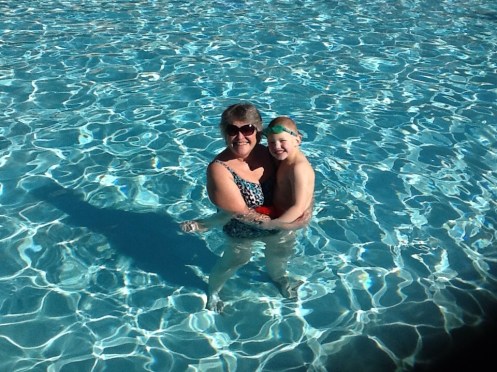
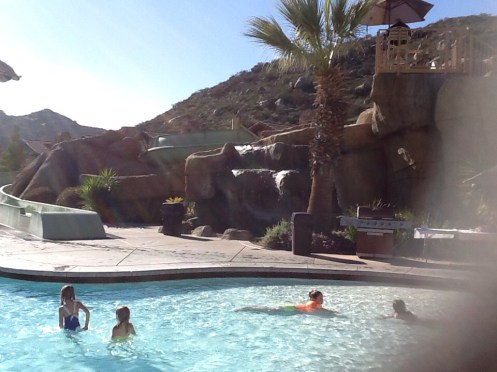
Flopped around the unit for the morning, light breakfast, and swimming in the afternoon. Low seventies and sunny with a slight breeze, so very pleasant. Baron showed no hesitation about climbing up and coming down the curvy and fast water slide, so of course Jim had to follow, and Paula took her turn, too. There’s video to prove it, but it appears that this WordPress app doesn’t countenance video, so these shots will have to do.
This evening we plan on dinner at Hunter steakhouse at Carlsbad, figuring that Baron will dig the salad service. The server comes around with a miniature salad bar on a wheel, and you ponder and pick. Jim and Paula are fans of the beef there, and the horseradish sauce that will lift the scalp right off your head, and comes with a server’s warning. By now, there’s probably even a written informed consent form.

French Toast from ciabatta bread, with soy milk strawberry yogurt and fresh strawberries ($1.99 a pound today at Von’s – California!) for Baron’s supper after his tour of the Mexican restaurant, the beach at Oceanside, and Orfila vineyards (another of our annual favorites) on the south side of Escondido. Monga and Poppa dined in-house on rotisserie chicken, rosemary roasted potatoes, and roasted broccoli, which would otherwise have been an easy sale but for the strawberries.
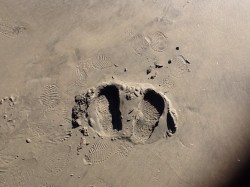
His Crocs leave a reminder in the sand for all to see … within the next few minutes if they’re lucky.
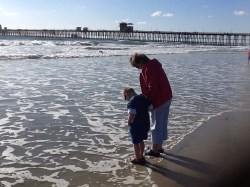
A light breakfast, and brief trip to Von’s and Radio Shack to pick up necessaries (Radio Shack survives here mostly on toys, phones, and phone accessories) and then to El Norte in Carlsbad. This is an annual favorite that we insist on sharing with family and friends, a stone’s throw from where Paula’s dad spent his last several years. Baron really liked his mahi mahi enchilada, finished his plate along with a lot of chips and salsa. No photos. But then up to Oceanside and the pier and his first encounter with the Pacific, which had to be documented, as was his older brother’s encounter.
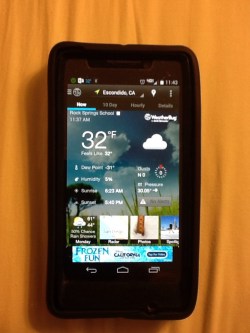
Slept in, easy day. Woke up, coffee, how’s the weather? Check Weatherbug on line. Hmm. Something wrong here. The pws (private weather station feeding Weatherbug) at the elementary school in Escondido reports exactly 32 degrees, even with a couple of browser refreshes, yet decent temperatures persist here only 10 miles away. Maybe some prankster has embedded the school weather station in ice.
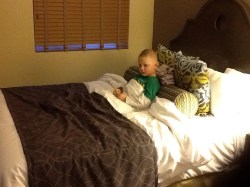
Baron has chosen his bed and is ready to crash…not. The picture is taken at 5:30 PM, but he continued well into the evening, ricocheting between his bedroom and the living room. Bedtime at 9 enforced.
There is one in San Diego and another in Solana Beach. We manage at least one visit each year. This year we ate our first meal in CA here, where they offer the ginger lime prawns as an appetizer – more than the sum of its parts and not on offer at Solana Beach. Ya gotta know these things.
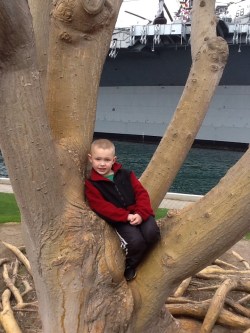
Part of the park alongside the USS Midway includes these trees which were also greatly favored by the busloads of posing Chinese tourists and their selfie sticks, and Baron was finally able to nestle into a tree for a picture.
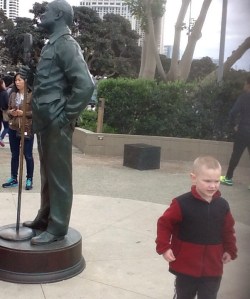
At the same area there is a statuary tribute to Bob Hope, who stands before a microphone before a small crowd of various service men and women from various eras. A recording plays clips of various performances at bases and camps. The park was flooded with Chinese tourists, chattering and posing for pictures in the trees, with the various statues, and the ship. So many of them pose interactively with their background – Vanna White could learn from them. Baron, on the other hand, has no interest in posing with Bob.
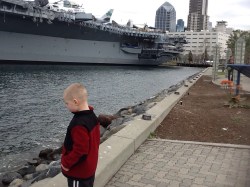
Lunch is in the air for folks whose internal clock is at 12:30 while the world around is at 10:30. So it’s a jaunt down the Embarcadero to cool our heels until the Fish Market restaurant opens. It’s right next to the USS Midway, which mildly impresses Baron, but a poor second to the discovery of “Seagulls!!!” Shrieked at every new sighting – about every 17 milliseconds. Pray he becomes habituated soon.

First stop for young and old in California after landing – the restrooms. This is a neutral territory restroom at the airport.
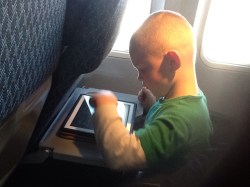
Alarms at 4:45 for a 7:15 flight. Several alarms set on two phones, one iPad, and a robo wake up call from the hotel system. Baron woke with the first alarm and was ready to get dressed and out the door. He has to be persuaded to sit down and have some yogurt while we re-packed. He is provided with dry cereal and fruit roll-ups for once we are on the plane, and we made a communal project of peeling and sectioning and bagging several tangerines last night for the flight as well.
We made a project of trekking down to the lobby and fetching the luggage cart, which he pushed all the way up the lobby ramp, onto the elevator, and down the hall into the room with any damage to himself, the cart, or the building. Once loaded, however, the cart proved more than the fellow could manage, and Poppa was called into draft horse service.
The early morning is frigid, with wind chills in the school-canceling range, and the car makes reluctant twitters under the hood as the belts warm up. The Humphrey terminal is our exit point, about a rifle shot from the hotel, and the car hasn’t time to warm up, so we’re pretty chilled driving into the parking ramp. We eschew park and fly this trip, looking toward a rapid return to the car and getting the youngster home in shortest order for bed and return to school next Sunday.
“Value parking” at MSP at Terminal 2 is in the Purple Ramp, and is relatively open at this hour on a Sunday, so the hike to the elevator (and heat!) is short, but brutal, nonetheless. We leave winter coats in the car, put on our California jackets, assemble the rolling luggage, and make for the automatic doors, old bare hands and small young hands protesting the cold for the whole fifty yards.
Lines at security are long and daunting as we walk into the terminal, but the lines at check-in look longer, positively Disneyesque. Paula expresses some concern that an hour and 45 minutes will not be enough time to get to the gate, but we clear it all in good time, and board the plane without event. Baron’s excitement is palpable as he slides into his window seat. The plane is slightly delayed as the baggage handling equipment expresses its own pique at the cold and the early hour, and even the de-icing seems to proceed at a glacial pace. Soon we are taxiing at a good clip, positioning on the runway, and accelerating to take-off. Baron’s cries of “Awesome!” punctuate the acceleration, rotation, lift-off, and first views of the city from above.
Settled into the three hour plus flight, we each turn to our respective tablets. Baron has his own family Samsung tablet, and Angry Birds seems to keep him satisfied and amused once the ground and clouds are far below and the endless sky provides no further entertainment. Descending into San Diego should prove interesting, as the plane has to come in low over the mountains and then drop down quickly to the airport at the edge of the ocean; we expect more awesomeness.
Travels with Baron threatened to start inauspiciously, as mom reported both boys complaining of upset tummies on Friday evening, coupled with a preceding note from school advising parents of circulating illnesses. Turned out to be highly contagious nerves and excitement that quelled by bedtime.
Saturday final packing crept on apace, with several calls between households reassuring that we were indeed going to travel. Target departure at 2 PM, overshot by about 20 minutes, not bad. Picked up Baron, supervised goodbyes and hugs, strapped him in, and set off to the west. Chatter lasted about 30 minutes, and then the piper of missed sleep claimed his due, and Baron slept to almost Menomonie.
We checked in at the Hilton near the airport, claimed our room and repaired to the bar for a restorative. Baron claimed his seat at the bar, son of Wisconsin that he is, and we were gently reminded by a waiter that culture in Minnesota is a little different and children may not sit at the bar. Perhaps this is to assure room for more serious imbibers.
We took a table in the bar, and the server provided Baron with a children’s menu and crayons: a brand new box of 16 – count ’em, 16 – Crayolas! Wisconsin could learn something from Minnesota, not only in politics, but in customer service.
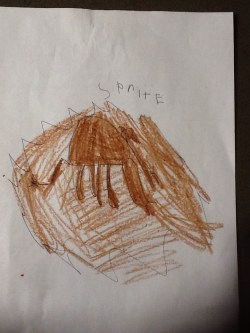
The result of our extremely satisfying dinner is the art work below, created on a tummy full of mini corn dogs and apple juice and seven olives and a few desultory french fries. This study in brown and white represents a mud-covered elephant wallowing in a mud puddle.
Early to bed (good luck wi’ dat) and an early rise tomorrow. Flying out of Humphrey terminal on a 7:15 AM flight, so you can guess rising time…
As predicted, there was no question in grandson Baron’s mind that this was the year to go to “our California house.” He’s alive and 5, and those are the only qualifications. Carrie, his mother, confesses that it was harder letting Allen go with us five years ago and have him absent for a whole week. This time will be easier, she says. Dunno whether that indicates greater maturity on her part, greater confidence in us, or her looking forward to a bit of a break from a chatterer with a recurring case of the zooms. So our tickets are purchased and we’ll be headed west on Saturday. Scott will stay at the house and tend the animals, and we will drive to the Twin Cities with Baron, spend the night near the airport, a hotel and restaurant experience for the kid, and fly out bright and early (red-eye flight) on Sunday. We’ll get into San Diego earlier than usual, so will have time to kill before heading up to the resort for an afternoon check-in. Hoping to make contact with sister Nancy, and perhaps another friend currently living on a boat in San Diego Harbor.
When Allen went west 5 years ago, it was with Paula only, Jim having to stay on for a few meetings in Madison and joining them later in the week. Consequently, he missed the trip to Sea World and other exploits, but was in on the trip to the Wild Animal Park and Orfila vineyards. This year we’re five years older, chaperoning an extremely curious, distractable, and yes, less biddable version, Grandson 2.0, who has been hyped about the trip by stories told by his older brother and friends at school. Already he has been told that there’s a Legoland theme park near Escondido, as well as other things to see and do, where Allen had only vague presentiments about the storied paradise that is California.
Traveling with Baron will no doubt be a challenge. We had a planning meeting with his mom over breakfast on Friday, giving her a list of necessities and not-so-necessaries, Baron has a peanut allergy, so epi pens will be our constant companion. Part of the planning meeting focused on epi pens and back-up pens, and health care directives, and peanut dust in the air in the airplane cabins. Lactose is still an issue, albeit a diminishing one, and he seems gradually able to tolerate cheese and milk. On the other side of the menu, however, he is quite eclectic in his tastes, and will probably be game for some more exotic fare out there. We have a couple of favorite restaurants that we manage to hit each trip, and we hope not to be bound by hamburgers and spaghetti.
When Jim was a little over two years old, he was on a train trip with his father and two older brothers, traveling from New Jersey to visit grandparents in Waco, Texas. This necessitated a layover in St. Louis, and his father proposed to take the boys to the St. Louis Zoo. Bags were lockered at the railroad station, and they headed for the taxi rank, and at the bottom of the Union Station steps, Jim slipped hold of his father’s hand, and bolted for the street. A flying tackle prevented him from becoming a statistic, and the fright was of sufficient magnitude that his father went immediately to a harness maker in Waco, and had a leather harness and leash crafted, to which Jim and his younger siblings were subjected in crowd situations for years following. Somewhere in the family archives, there is a picture of youngest sister clad in sundress and the harness held by her grandfather standing by the river. All this is by way of expressing the nervousness of traveling with fast-moving short people. Jim doesn’t move as fast any more, and is much less likely to slip hold of an adult hand and take it to the street these days, but there’s no telling when a sturdy, healthy five year old may bolt, so it’s a good thing that this trip out and back will be double-guarded. On the other hand, the crowds, bustle, and new surroundings may be so awesome that Baron will want to stay close and chatter about everything he sees. Either way, it will be entertaining.
We make an annual trek to SoCal around this time to visit our timeshare north of Escondido. Four years ago we took grandson Allen along with two purposes: to meet his great grandfather, Ray Jones, and to acclimate him to flying at an early age. Well, not so much the latter, although his father has little desire to strap himself into an airplane. Allen dubbed our timeshare condo “our California house,” and refers to it frequently in the never-ending quest to assert superiority over lesser beings, such as his brother. This naturally creates puer pressure on us to take Baron along some time, and next year will probably be the opportunity to take him along, before he’s shackled to a school desk.
Our planning started in the fall, as Paula started combing the websites for flights to San Diego. Finding the most reasonable fare, she booked us on United. It wasn’t a month before United messaged us with the dreaded advisory that the gnomes of customer service had changed our itinerary, so that instead of returning from SD on a 10 AM flight, we would be the not-so-happy participants in a 6 AM flight, necessitating leaving our Escondido residence at 3 AM. Oh, and should we wish to modify the modification, that will be $150 each, pus the difference in the then-current fare. This is the penalty for grabbing the early fare, and booking through the UA website. Here, folks, bite on this bullet.
We shoulda known. They did this to us before. And when I called to remonstrate with them, they agreed in subcontinental accents to change back to our original itinerary for a total of $100, which I accepted, only to see a $250 charge on the credit card bill after the fact. This harkens back to the old perfume ad – promise her anything, but give her Arpège. Anyone old enough to remember that?
Our journey started inauspiciously. 15 minutes late out the door from home this morning. We took the older car, since we would be leaving it at the airport for the week. But after the winter storm of the past two days, the driveway sported a wide and attractive snowdrift, which the lighter, older car was fascinated by and insisted on visiting with and wallowing in. James piled out and went for sand and shovel, which proved only marginally helpful. Cameron’s supply of kitty litter was not far from our minds. But Jim’s pushing skills have only slightly diminished, and between the shoveling, the sand, some rocking and rolling, and some minimal tire traction augmented by his non-cleated footwear, Paula managed to steer us out of the drift. With a little more speed, we cleared the drift and were on our way down Mt. Franklin and on to CWA.
Traffic is light in Wausau before 5 AM following a snowstorm, and plows were out and struggling with drifts and underlying ice. Add to this the bobbling left wheels of our car, due to remains of the drift caught in them, and it was vaguely reminiscent of an earlier trip to Madison to catch a flight to the same objective several years ago.
HOWEVER — first we scored a parking place at the airport not 50 yards from the entrance and exit for when we return with only spring-weight outerwear, and second, the United agent was able to revise our outbound itineray, so that we only had a 2.5 hour layover in Chicago, instead of the six hour layover that United had vouchsafed us in the first place. And Economy Plus seats! Oh, rapture! But not together. Oh, modified rapture!
CWA has been substantially remodeled. It’s not quite a stately pleasure dome, but they have installed a café area on the concourse past security, replacing the makeshift cubby that had a coffee pump pot in the corner. And when we return, who knows what garden of earthly delights will greet us in the arrivals and baggage claim area, now that all the car rental counters are moved across the road into the new building.
Passing through security, we are each given a laminated pink card when our boarding passes and drivers licenses are returned. This is not an indication of a personal foul we are told, but rather entitles us to keep our shoes and light jackets on as we pass through the metal detector arch. Sweet! On the other hand, there is also a sign indicating that all passengers over 75 are allowed to remain in their shoes and jackets. There was no inquiry, so the driveway adventure must have taken more of a physical toll than we realized. Note to self: don’t forget to refresh make-up when travelling. And the cards are collected on the far side of the metal detector, so as not to tempt us to sell them as Monopoly Chance cards — Pass Preflight Security and collect $200.
40 minute flight to Chicago, where the electronic departure board greets us with our next gate assignment, C5. First breakfast at an in-terminal Chili’s, which is interminable as to seating, service, check presentation, and collection. We’ve done the terminal shift before; it’s a two minute shuttle bus across the tarmac to a midfield terminal, and we charge right over to the steps and down to the bus which whisks us away. And C5 is immediately to our left as we enter the C terminal, so we sit down to wait.
But wait: something seems not right, since we are apparently in puddle jumper territory with planes loading and departing for Moline, Rochester, and other insubstantial airports. Check the board again. Oops, now it’s B5, changed while we were shuttling? Insidiously perfidious, these United. We might even call them the Damned United, but that would refer to a Manchester soccer team. This time we take the underground tunnel, with the strange music and ever-shifting neon lighting, arriving in good order despite United’s best efforts to lead us astray.
There again, the gods smile upon our travails, for there are still two seats available together, but not in Economy Plus with extra legroom. They are back in steerage among the goats and chickens, where compression is good for the soul, but the lure of sitting together and getting Paula through the take-off, landing, and turbulence in between makes this more attractive. And so we accept the revison, board the plane, and depart.
This is our first flight with the new electronic devices rules, and the only stricture seems to be to turn off our cellular communications, so in Airplane Mode, our various electronic tethers can remain functional, and between snoozes, we entertain ourselves with sudoku, solitaire, audiobooks, and device-centric fare, for United now demands a fee and a credit card swipe to access anything on the seatback monitor — including the in-flight map and flight progress report. And this is because of the proliferation of electronic devices with which passengers can determine the selection and timing of their own entertainment for the duration of the flight. So rather than meeting the competition, the idea is to go in the opposite direction. The supply/demand curve of perfect competition seems to have faked out the airline’s offices.
What can you say about flying these days — except maybe Ow! The seats have improved vastly in the last years, at least from the bean counters’ and vicarious contortionists’ points of view. They are marvels of discomfort in all dimensions and directions. If we were issued oars, we could at least claim professional pride in helping the ship get where it needs to go. But the seats are little more than wooden pews of a particularly Calvinistic inclination and the enemy of any body type or spinal alignment, and the passenger-packing algorithms could teach the designers of Tetris a few tricks.
Enough said about the interior. Minor turbulence on the outside at the first hour becomes an excuse for seatbelt sign for the 3.5 hour balance of the flight and for flight attendants barking about congregating in the aisles, as passengers struggle to extricate themselves from the Iron Maiden seats and to disentangle themselves from other seatmates in order to take advantage of the on-board facilities. Flying: it’s a young bladder’s game.
Flying into San Diego is a pilot’s challenge, as the route takes us over mountains and into an immediate drop to sea level, with an airport that is located at the water’s edge. So the drop in altitude is reflected in the rapid rise of cabin pressure. Hard on these old ears, and on young ears that are stuffed up with winter colds. But we make the landing with only some minor bouncing. And as they say, any landing that you can walk away from — is an indication that the airline seat designers still have not achieved their goals.

Another rainy day in Ireland! But we are taking the bus down to Mizen Head, and there are rumors that the weather is going to break.
Mizen Head is reputed to be the most southern tip of Ireland, that’s a wee bit of an exaggeration. But it is a prominent promontory. It’s a rocky coastline and Mizen Head is the location of a lighthouse, and former signaling station. It is one of the featured locations of Guiglielmo Marconi’s experiments with transatlantic radio communications and the first undersea telegraph cables.
Arriving at the visitors center, the first order of business is lunch, and they accomodate our large group slowly but satisfactorily. Being early in line, we get a chance to wander around the visitor center, which features displays about the construction of the lighthouse, lighthouse life and people, and navigational aids from lodestones to GPS. Following lunch there is a ramble out to the lighthouse on the promontory. Despite hopeful predictions of a break in the weather, the weather breaks into some of its worst behavior. It starts as rain and wind.
The path to the lighthouse is an asphalt walk down switchbacks (or 99 steps if you’ve an intrepid spirit) followed by a footbridge that crosses a gorge hundreds of feet deep that essentially divides the promontory into an island. Then it’s a further walk out to the lighthouse with a detour up stairs to an observation platform that commands a view to the south and north of the promontory.
Paula dares the walk and the bridge and the observation platforms, and specifically wants proof of being out on the bridge, but we are not quite equipped for the walk out to the lighthouse, for the winds have picked up to 35-40 mph, and the rain has turned to sleet, the asphalt walk becomes icy, and neither of us is equipped with more than a rain parka, so we turn back. But not before documenting the feat.

The pink dot in the bridge arch is Paula, leaning over the rail, peering at the seals cavorting in the surf hundreds of feet below.
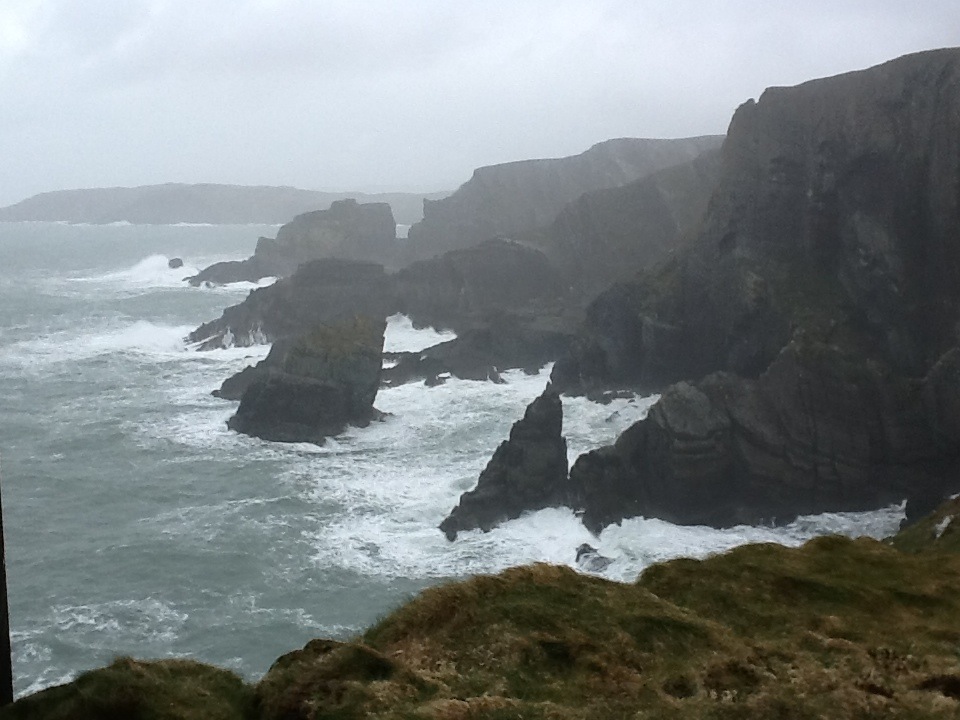
And this is a view to the north from the observation platform.

Others in the group have gone out to the lighthouse, so we have time to get somewhat warmer and dryer back in the visitor center while they make the trek back. It has been a cold, wet, slippery, windy and freezing sort of day, but it is nevertheless one of the more significant features of the tour, and one that Southern California group members will talk about for a long time.
After dinner, music in the Park Hotel pub. Again, a smallish pub, and we stuff it with tour group members, locals, and assorted musicians. That’s really one of the salient features of the tour, the opportunity to sit and chat with locals, and their willingness to bring out an instrument, or volunteer a song or a request for a song or tune for the amusement of all.
Paula and I go back to Casey’s and stop in the pub for a nightcap, and encounter Donald chatting with Fraser, a long-time friend of Donnie and James, who has driven over from Scotland to join the group. Fraser was once a professional musician that often played in this community, so he knows a lot of the locals, and is quite at home in this particular establishment. Donnie joins us, as does Jeff and the evening wears on and the drinks flow on, and the stories are funny, and it’s a nice quiet end to the day.
The weather isn’t breaking, and it seems not a good idea to pursue the activity planned for the day, involving a boat ride.
There are rumors, however, of an interesting feature to the north of town called The Ewe. It’s described as a whimsical sculpture garden, and is initially touted as something that the womenfolk might enjoy more. But many are game, and the bus loads up and takes us to a driveway that we passed on the way into Glengarriff, recognizable because of a sheep half out of the sunroof of a car, holding a pair of binoculars and with a map spread out in front of her.
The bus has to drop us off quickly, becaus the highway is narrow, with no shoulder and no chance of turning in or turning around. While we are visiting the place, Martin will drive the bus up several miles to Mary Galligan’s, turn around and wait for a while, and then drive back to pick us up, and everybody has to be at the gate and ready to board, so as not to hold up traffic any longer than necessary.
The garden is privately owned and developed on a hillside, and features about 45 sculptures, all made out of recycled materials, with signs presenting jokes, puns, poems,quotations, history, and commentary. For an admission fee of ten euros, the visitor follows a path past all the sculptures.
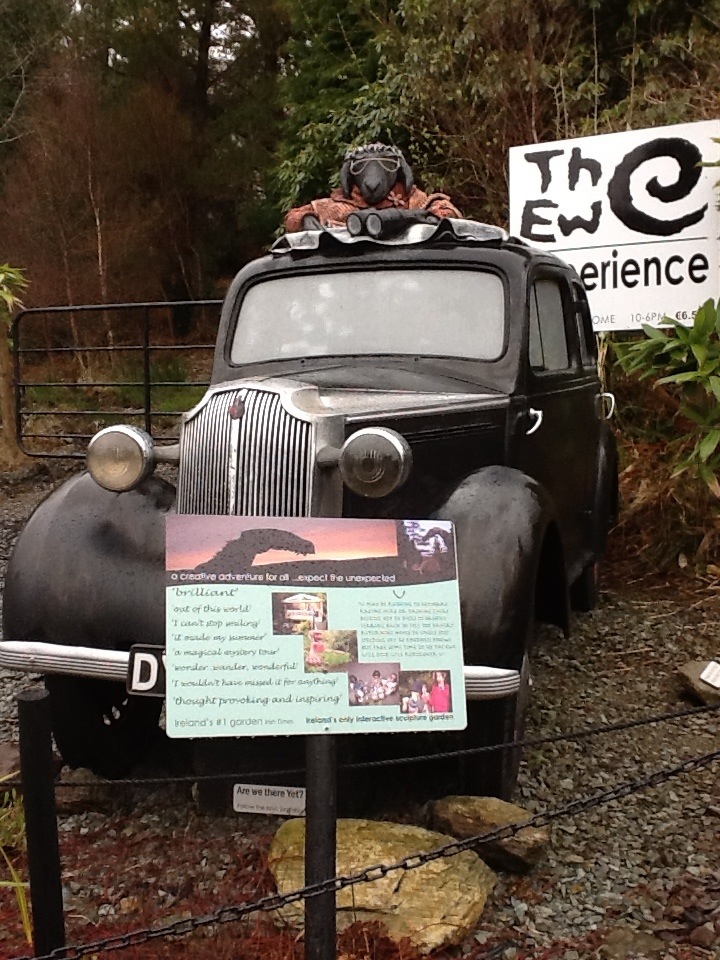
Titled “are We There Yet?”
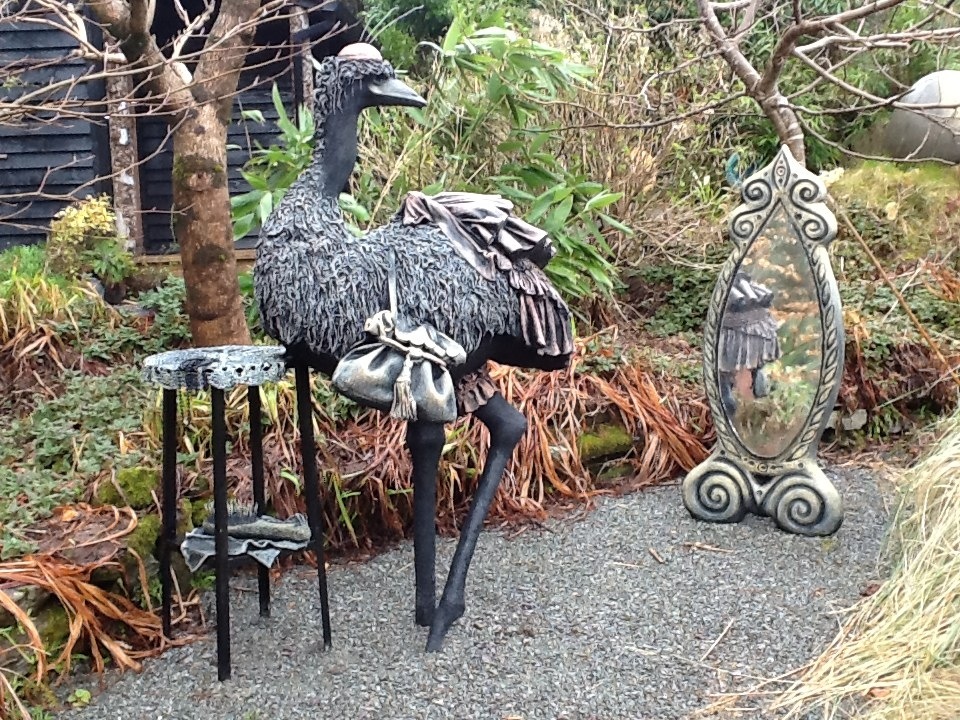
Does this make my butt look big?
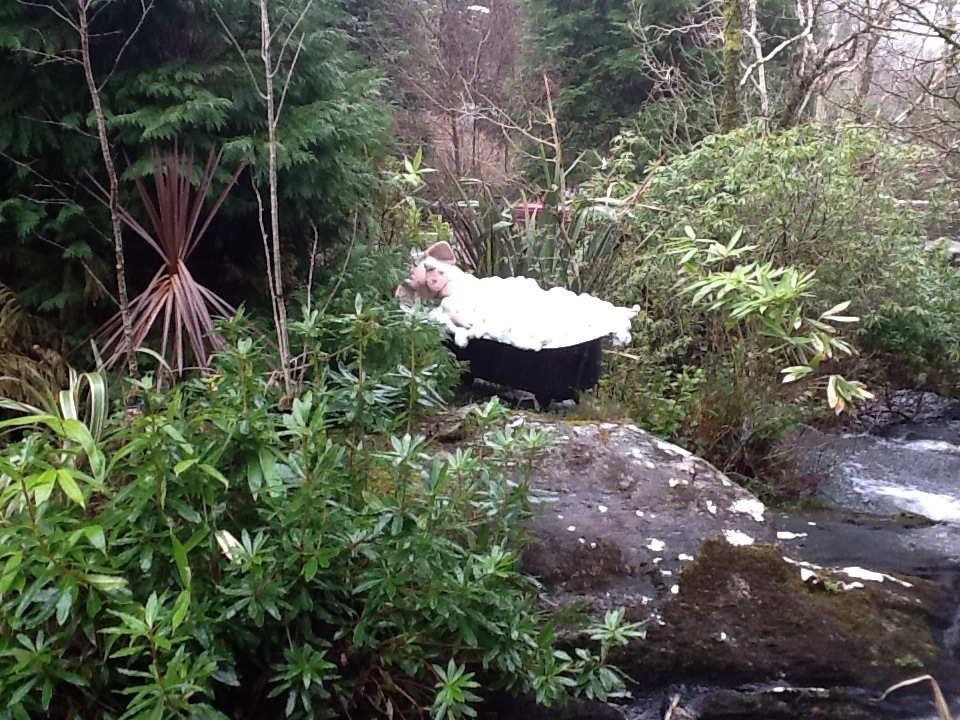
Happy Piggy in a bubble bath. For some reason, this resonated with Paula.
The afternoon’s activity is a ride out to Garinish Island. This involves a small ferry, passengers only, and it requires two boats to get us all across. Our pilot is Kieran, the button box accordion player who joined us in the pub the night before, and the pilot of the other ferry is his father. The ride is about 15 minutes out to an island in the protected northern corner of Bantry Bay, that up until a hundred years ago was a military lookout position against French or Spanish invasion. It still features a Martello Tower, a round tower that once served as a lookout point and a cannon emplacement with a swivel mounted cannon, ready to resist invaders up the bay. A hundred years ago it was a bare rock, but was bought by a citizen and over time was covered with soil, planted and converted to a garden island in a relatively protected part of the bay. It features plants and trees that otherwise would not survive in Ireland, much less on its west coast, including jungle plants. It is accented by a walled garden, pavilions, and even a Roman temple overlooking the Bay.
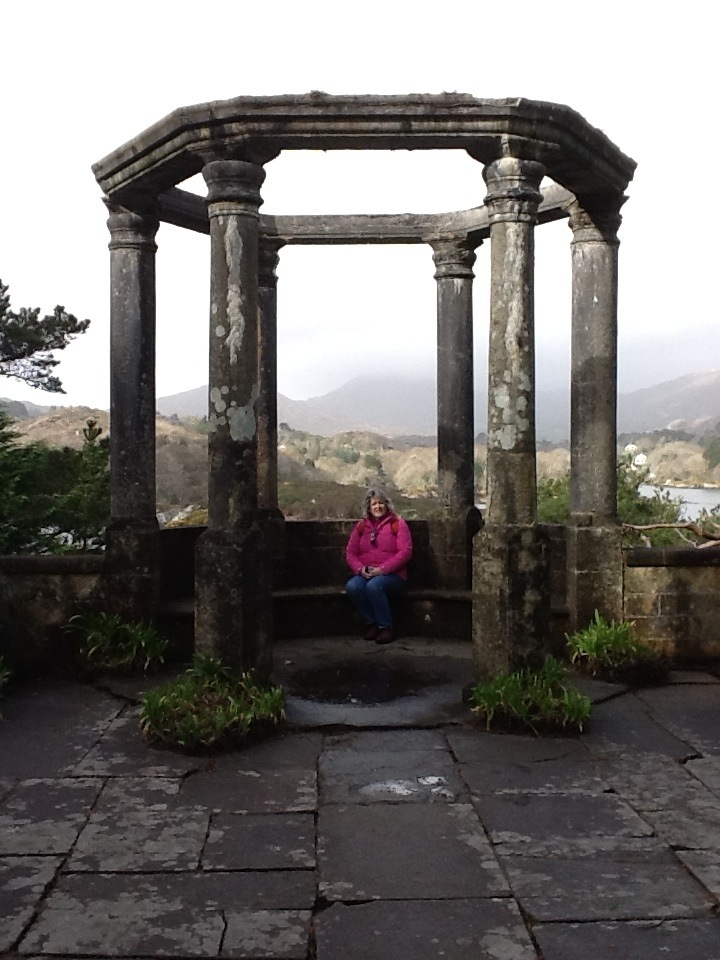
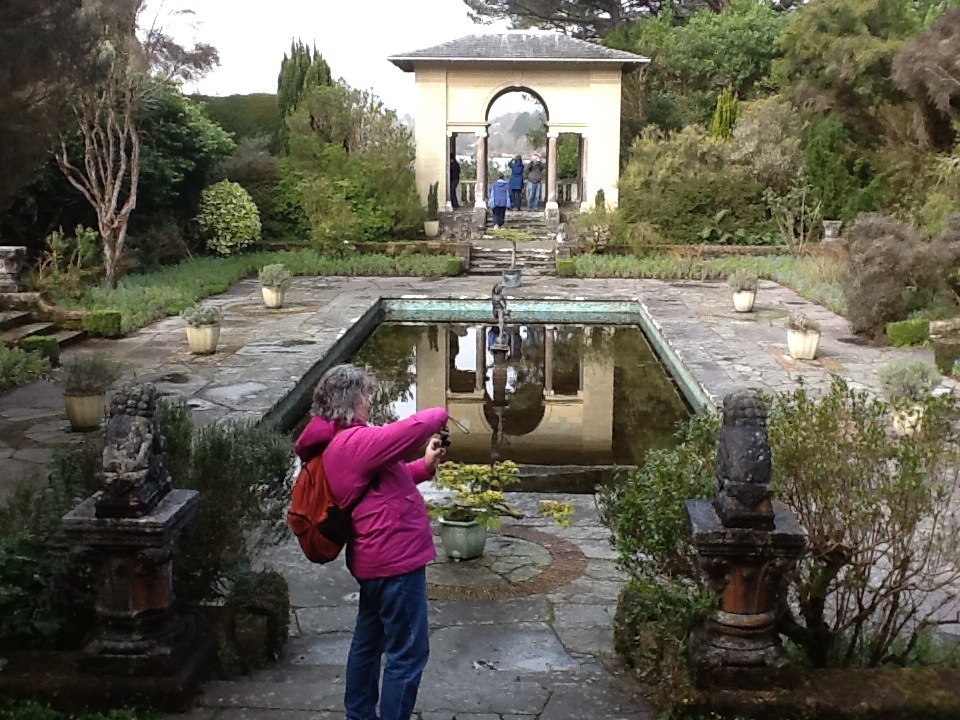
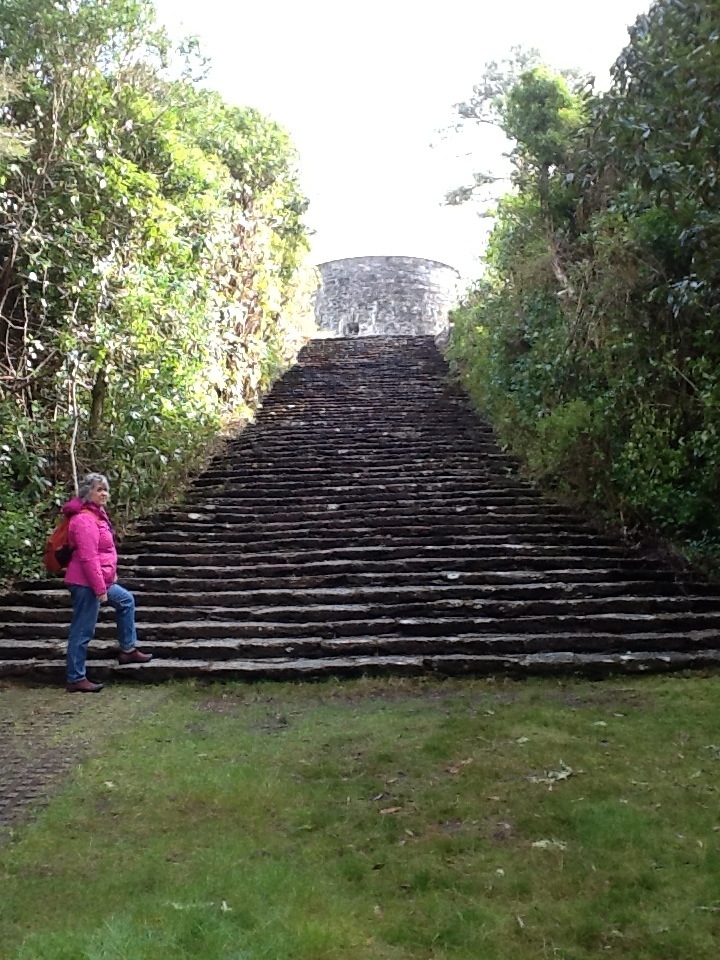
Return to the hotel for a short nap, and dinner, and music. It’s a wonderful life.
Glengarriff is a little town on Bantry Bay, to the northwest of Bantry at the northernmost bit of Bantry Bay. As earlier described, it has a couple of hotels, several various shops, and is the jumping off places for our further explorations.
It’s raining on our first full day in town, and there are various activities proposed for the morning. First is a seven kilometer hike, about 4.5 miles. Not appealing. Another choice is a ramble up to the nature preserve, about 3 km. Only slightly less unappealing. How about sleeping in? That’s a winner. So we miss breakfast on the first morning. OK, as the breakfast is the usual Irish breakfast, one fried egg, two sausages, bacon (which is more like Canadian bacon), sauteed mushrooms, and black and white puddings. Plus openers of cereal, fruit, juice, prunes, and toast. How do we know what we missed? We interpolate from every other breakfast.
At eleven the tour group rendezvous at the Park Hotel, boards the bus, and we travel to Bantry House. This is a manor house first occupied by a gentleman of merchant family who won favor with the English King George for having been alerted and responding to an attempted invasion in 1796 by Wolfe Tone and a contingent of Irish nationalists supported by an armada of French soldiers and sailors in hopes of pushing the British out of Ireland. The invasion never actually happened, as the west Ireland weather did to the French what it had done to the remains of the Spanish Armada, sinking 10 ships, and putting any survivors at the Mercy of Richard White and his loyal followers. As a reward, the Crown increased his lands and elevated him to Baron, Viscount, and eventually Earl of Bantry. The house remains in the family, and much of the interior is orginal, and one of the descendant multi-degree granddaughters is the general manager, and shepherds us around, and even gives dispensation for photographs, not usually allowed. Even allows a few of our group to play the piano in the great room.
Lunch is in the House tea room, but they weren’t exactly expecting forty hungry tourists, so things ran out, especially the soup, which was appealing on a chilly, windy day. Not a great day to tour the gardens, which are well tended, but bare at this time of the year. Still Jim makes the trek up the 100 steps to get a few pictures of the house and Bantry Bay beyond.
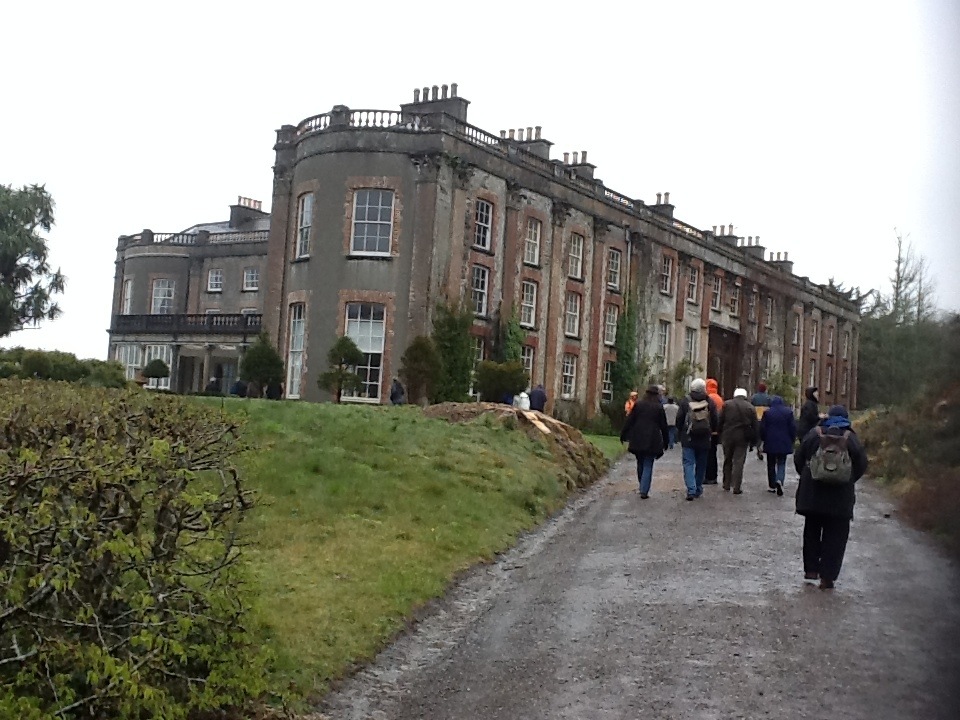

After the house tour, we drive on down into Bantry town, for some shopping and perhaps a visit to a drinking establishment. Bantry area features several homages to St. Brendan who set sail from there to the west and is said to have arrived at Newfoundland. So the central square features a statue of Brendan in a King of the World pose, dwarfing the cowering sailors.

Shopping is successful, and a pint is welcome at one of the many along the main shopping street.
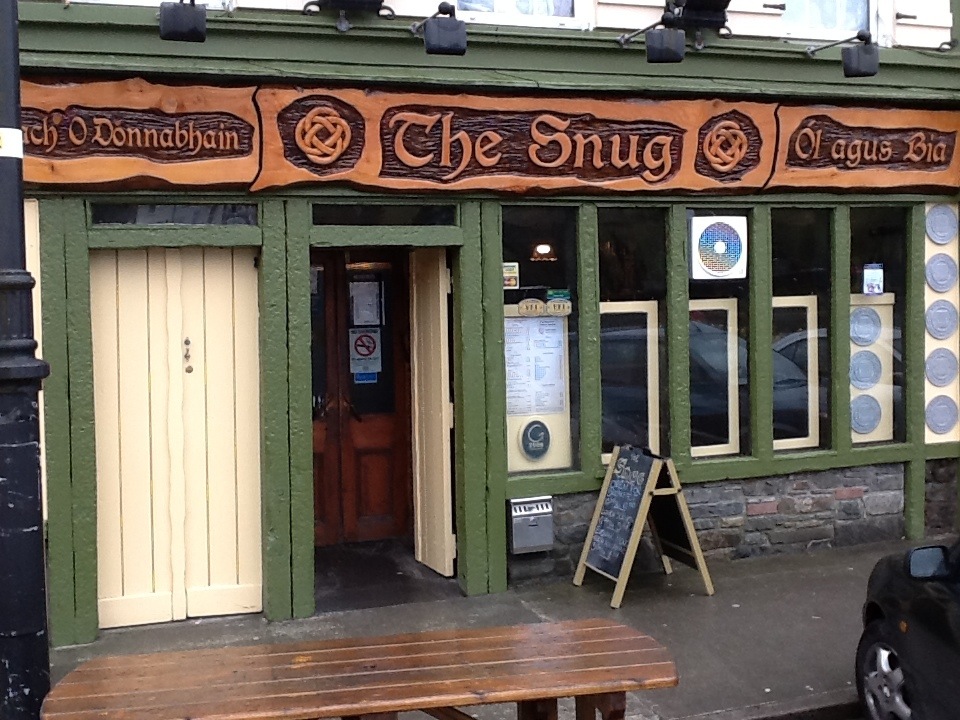
We didn’t hit this pub, but were intrigued by the name. We have been told the the “snug” is by old tradition, the women’s part of a public house (tavern) and was usually a small section off of the main room where the women wouldn’t readily be seen consuming their pints. In the pub that we stopped at, however, one of the featured decorations in the main room was a framed set of American Civil War relics: minie balls, grapeshot, remains of a pistol and a rifle, sword, bayonet, buckles and buttons.
Back to the Hotels and a quick nap, followed by dinner and music in the Casey’s Hotel pub. This time, the locals have gotten wind of music, and the pub, not large to begin with, is shoulder to shoulder with our group and locals, with barely enough room to change your mind. And as the eavening wears on, additional locals come in, including a local teenage ceilidh band, one of whom sings the Ratlin Bog song, a song that repeats and adds verses, and accelerates faster than any we have ever heard. We are not among the usual suspects who see the last dog hung tonight, but retire while the music and ambient temperature are still high.
Our fourth day for Killarney is actually a road day. Thanks to an early start we will do the Ring of Kerry, which is a trip down and around the Kerry Peninsula, a frequent destination for tour buses and drivers. It offers some spectacular views out over the Celtic Sea to the Atlantic, as the road twists its way around through small villages, up and down hills and around sharp bends on a fairly narrow two-lane road. The road is actually so narrow in places, that tour buses and semi’s are only allowed to make the circle counter-clockwise. We’re not sure if it’s the law, but it’s a good idea, and becomes obvious once you’ve seen the road.
Our first stop is at Killorglin, a little town on the northwest corner of the Kerry Peninsula. This is pretty much a potty stop in preparation for the Ring. We stop at the public restrooms downtown, right across the road from another hotel owned by the Huggard family, the folks who own the Lake Hotel. James runs across the road to chat up the hotel staff and scope the place out for possible future use. Not enough rooms, since there are inevitably some singles along on the tours and the hotel has barely enough rooms for the regular complement of couples. Nice enough place, but it wouldn’t do. In the meantime, folks work through the minimal public facilities, pausing at an artist’s shop that is incorporated in the building, and taking a brief walk up the main street. Then back on the bus (which by the way is not a bus, it’s a coach) and we’re off on our Kerry adventure.
An adventure it surely is. Kerry is farm country, and if you shop at Sam’s, you’ve propably seen Kerry Gold butter and cheese in the coolers. Actually, there’s good farming country from Kerry all across through Cork to the east, and someone (a California resident, by the way) comments to us that this is pretty much the Wisconsin of Ireland.
At a lookout point along the road, the bus stops for a leg stretch and a photo opportunity. It must be a popular stop, because at the turnout there is an unoccupied ice cream wagon, and there are two elderly fellows sitting by their little panel trucks, one with a small dog and three lambs sitting by the wall out of the wind, hoping that Americans will pay to take pictures, and another with a dog playing a button box accordion and keeping time stamping on a sheet of metal, again hoping that people will reward his efforts. It’s a windy site, and the low wall affords little protection, so the lambs huddle together on the asphalt and are definitely not in a gamboling mood. Paula nonchalantly wanders past them, but sneaks a picture of the lambs. And there is talk of Opportunities for Ice Cream at the next stop in Sneem on the south coast.
As we are settling in and about to get back under way, there is movement and a cluster of people looking for something toward the front of the bus. It turns out that one of the group has missed her purse, including her cash, cards and passport. This poses a problem in several ways, since without a passport or her cash cards, her further travels are hampered. And due to the travel restrictions on the Ring, since the bus cannot retrace its route and check back at the place we stopped, nor are there shortcuts back across the peninsula that a bus can negotiate.
Into the concerned cluster of husband, wife, tour leaders, and bus driver. steps Bronagh, James’s wife, with an urgent phone call from the hotel we have left earlier. Although she had been reluctant to answer her cell phone on a prior call, since the phone number was a Dublin number, this is now the hotel calling to say that a German tourist had found the purse in the lavatory in Killorglin, had found some hotel information in the purse and a cell phone number, had tried calling the hotel, and had been given Bronagh’s cell phone, and had tried calling Bronagh, apparently using a cell phone sim card purchased in Dublin for the vacation, and then the hotel called Bronagh to say that the purse had been found, and was being held at Killorglin.
Next problem, how to get back to Killorglin. It’s only about 15 minutes back, but the bus can’t go back, it can only move on. So James approaches the button box player, and offers him some money to drive back to Killorglin. The player responds that for that money he would drive to Shannon and back. So the two of them load up in the old rattle-trap truck with the dog, but leaving the button box sitting by the wall. And half an hour later, James is back with the purse, all funds and cards intact.
The trip back to Killorglin for James was interesting. In the way of conversation, James commented that really, the only thing he knew about Killorglin was a mention of the town in a song. Immediately, the driver launched into the song and sang it all the way into Killorglin, and all the way back after. The dog sang along for parts of the trip, between panting and licking James’s ear, not a great treat for someone who doesn’t care for dogs. And James says he met the German tourist, and not only thanked him profusely on behalf of the tour group, but also offered to forget about the wars.
So with valuables retrieved, we proceed on our way. The stop in Sneem is a lunch stop, and the group disperses in order not to swamp any one pub. The one we choose is a combination pub and convenience store, pub on one side of the wall, convenience store on the other. As this is the area that James has pointed out as a source for ice cream in Sneem, when lunch is over, some of the small group go next door to look at ice cream, and it’s soft serve out of a machine. One of outr group of four goes for the ice creeam, and it’s not until we get outside again that we see the store across the road offering home-made ice cream. Oh, well. There is talk about good ice cream at the next stop, at Mary Galligan’s farm, which is a shop and bathroom break.
On the way back to the bus, several of us gravitate toward a music shop near the town square where the bus is parked. Paula and I have heard a Mary black CD, and we’re in the process of looking at the CD’s with a couple of postcards already in hand, when James pipes up that for any of us on the tour, the bus will be leaving shortly and by the way, don’t bother with buying any music in here, the CD’s are outrageously overpriced, and the shop owner (who is at the cash register) should be ashamed of himself, and there will be much better selections and prices in Bantry and Cork. When the shop owner sputters, and says he has sale prices in the back, James says that they’re all crap, and €19.99 for current CD’s is a load of shite, and the bus is leaving. Tour members drop their selections, and move out, leaving Paula to cope with an sputtering shop owner to ring up her two postcards.
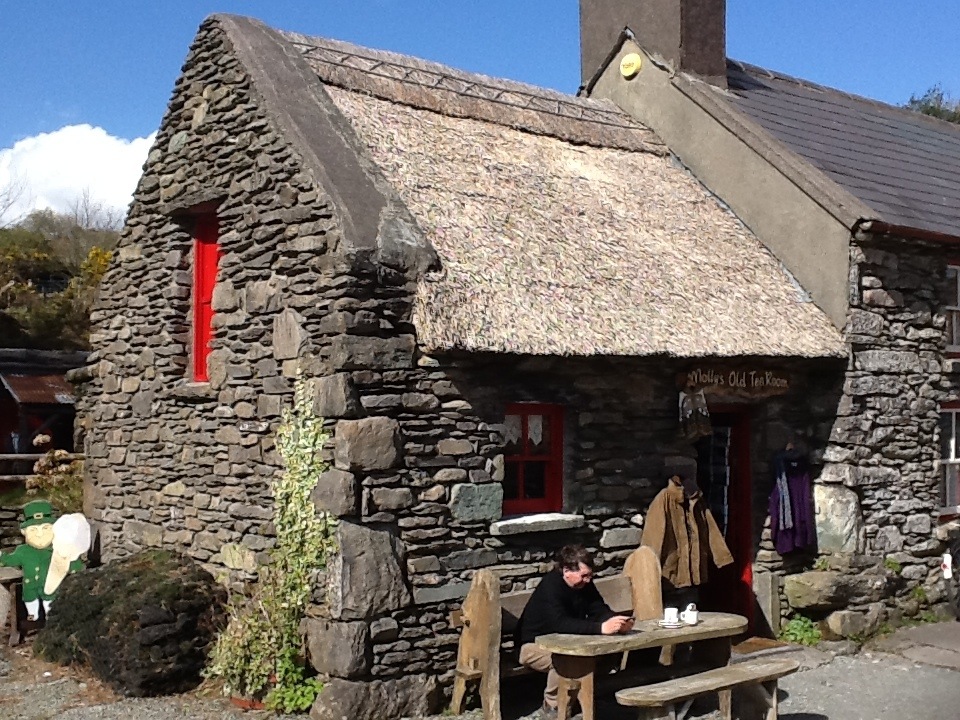
As promised, the next stop features restrooms, but no, it’s too early for ice cream, so their cooler is turned off. On the other hand, in the men’s room, there is a spider that James says is the biggest he has ever seen, stuck in the washing up sink, which he calls several guys in to inspect. Happily, he doesn’t share it with the women folk, since that would have put them right off their shopping. The store is an old cottage with a thatched roof, and several rooms equipped in cottage style — very simple furniture and tools, plus a shopping area witn touristy stuff and hand crafted items from around the area.
The final stop is in Glengarriff, a few miles short of Bantry on Bantry Bay. The group is housed in two different hotels, about a hundred yards apart on opposite sides of the street. Paula and I are in the smaller hotel, Casey’s Hotel, along with five other couples, witht he rest of them at the larger Glengarriff Hotel. They are both in close proximity to dangerously good shopping, featuring nice crafts, woolen goods, some music, and some nicer tourist goods and books.
Breakfasts for the Casey’s residents (we’re referred to as the inmates or the ex-pats) will be at that hotel, but dinners will be communal at the Glenngarriff. In the meantime, it is raining and cold, and the planned activities for the days in Glengarriff will be switched around in hopes of better weather. And there will be a concert after dinner in the upstairs gathering room.
Casey’s is only a bed, breakfast, and bar hotel, so there’s no loss of custom there, and the musicians in the group are mostly housed there, so they’re encouraged by the owner to sit in the bar in the afternoon and play, practice or share. And a pint or five is certainly as enjoyable there as anywhere else.
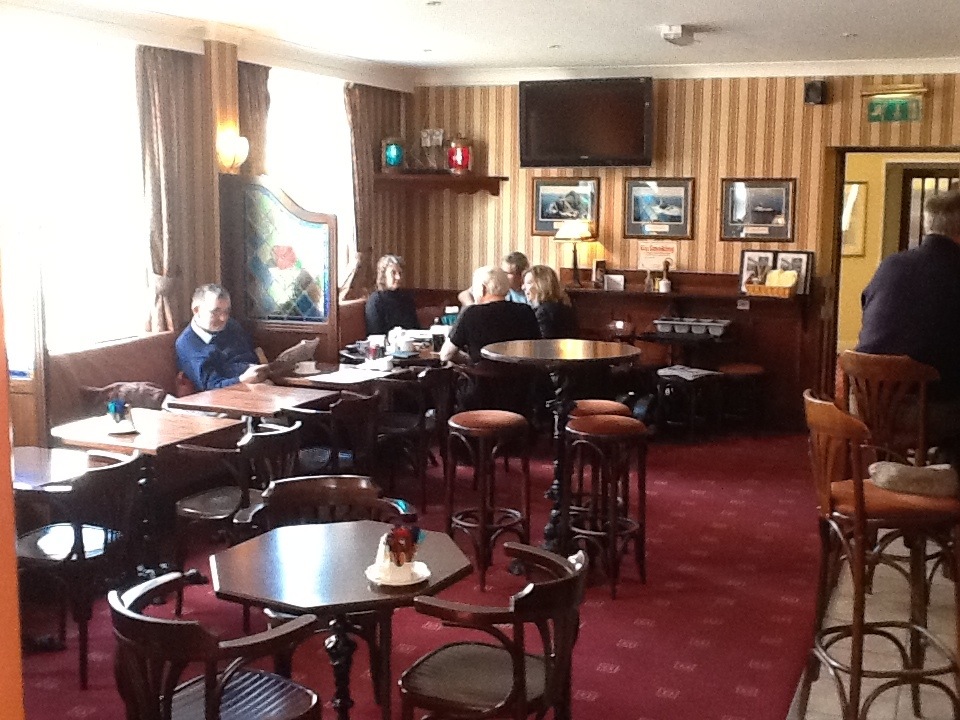
Dinner at the other hotel is surprising, in that there is a varied menu to choose from, all offered as part of the package, so after a brief nap and a pint at Casey’s, we are all treated to a huge meal, offering salmon, beef roast, steak, fish and chips, and etcetera. The dinner is delicious, served to individual order by a staff of three for 44 diners.
The concert after dinner attracts other locals, since there isn’t a whole lot else going on at this time of year, and among the locals is an American couple retired from living and working in Virginia, whom Paula chats up, and who are now permanently residing in Ireland and living in a house that is owned by the hotel owner, while she does medical transcription work to and from the States all by internet, and he does ***.
After the concert and social time, Paula and I stop in at the bar at Casey’s for a glass of wine. Paula orders a glass of white wine and I order a glass of shiraz and chat with the owner/bartender, Donald. When we finally announce that it’s time for bed, he bids us hold up and sample something nice, a white shiraz. .
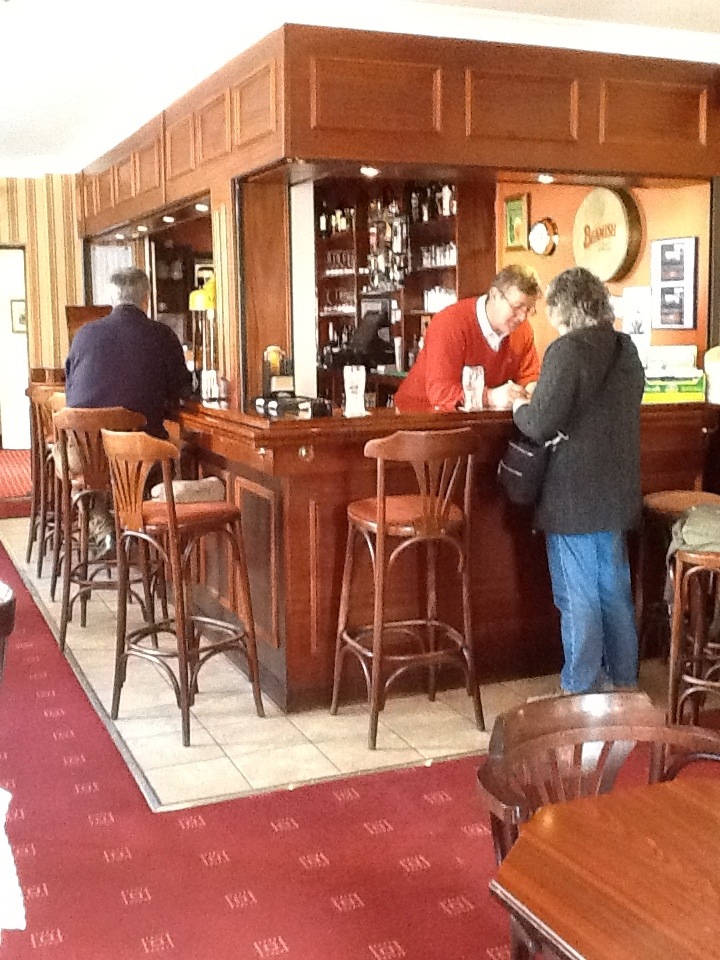
Suitably warmed by the conversation and the libations, we toddle off to bed.
Today is our third day in Killarney, a long one. We’re heading out to Dingle and Ventry. From there we’ll board a boat to plow out to the Blasket islands off the Dingle peninsula. Once a hardy colony of slate cutters and sheep herders, its last few residents left in 1953 and it is now a sheep and wildlife sanctuary. No predators to speak of for the sheep, except maybe the jackdaws that we are told prey on the new lambs. That seems to be a controversial subject, depending on whether you’re on the side of the birds or the farmers.
We set out at nine and we have a couple of stops in Inch and Dingle. Donnie points out that there are songs referring to Dingle, one of them being Dingle Bells.
West of Dingle is Ventry, where we unload and walk down to the pier. The tide is at ebb, and we have to transport our 44 travelers out to the boat in a Zodiac sort of inflatable, eight at a time, all stylishly attired in coats, hats, gloves, and orange vests.

This takes six trips and is the cause of no small trepidation, because getting down to the dinghy involves negotiating wet and slippery slate steps on the side of the pier down into a bouncy little craft, and none of us are interested in falling on the steps or into the bay.
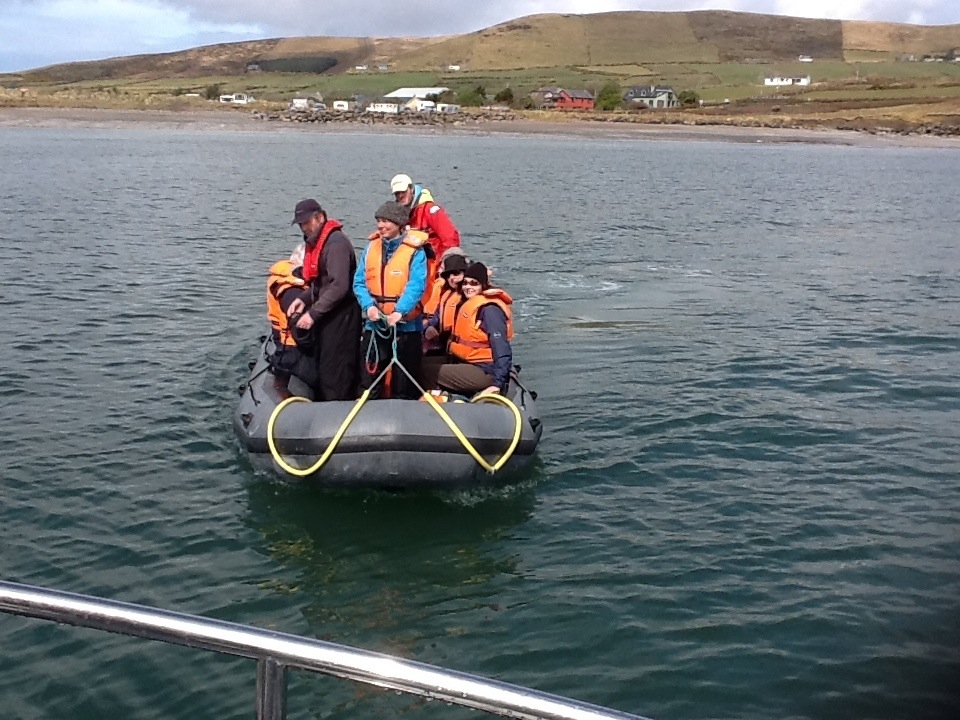
The process takes half an hour, after which we are given some simple instructions by the naturalist on board. We may see dolphins and basking sharks in the bay, since this is the time that they visit. If so, please everyone do not rush to the side rail. We will see seals, in large numbers, so don’t get too excited.
Indeed we see several basking sharks swimming in the vicinity of the boat and underneath the boat, somewhere in the neighborhood of 20 feet long, but they can grow to over thirty feet.

The trip to the Blaskets takes about an hour, and it involves getting beyond the limits of the bay in the doughty little boat. The swell is not high, and not as high as it has been in the previous days, but still causes some upset among our party, but everyone is happy to have seen the sharks.

Disembarking requires the same shuttling, and once on shore, we’re all challenged by a switchback climb up the wet slate rocks. At the top of the climb we are greeted by the sight of various ruined buildings, with a few that are yet intact, residence for workers during lambing season and shearing.
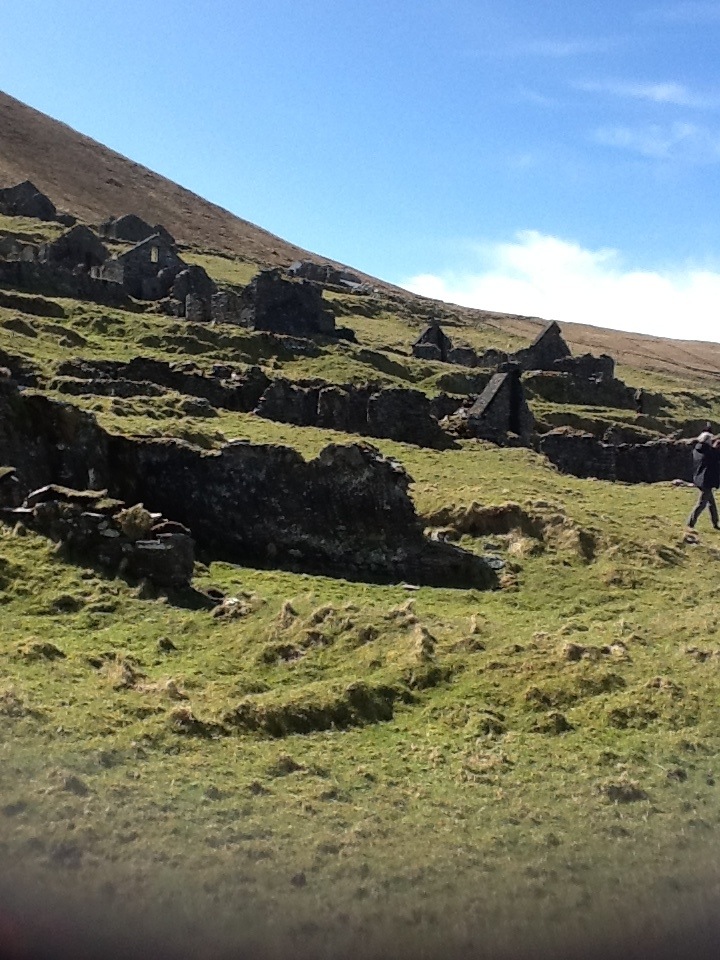
Back in the forty’s and fifty’s, the government announced it could not assure health or emergency care for Blasket residents, so the women and children moved off the island, then the younger men and the older men followed soon after, the last in 1953, leaving the island to the birds and the sheep. And the seals. The beach below was full of seals sunning themselves.
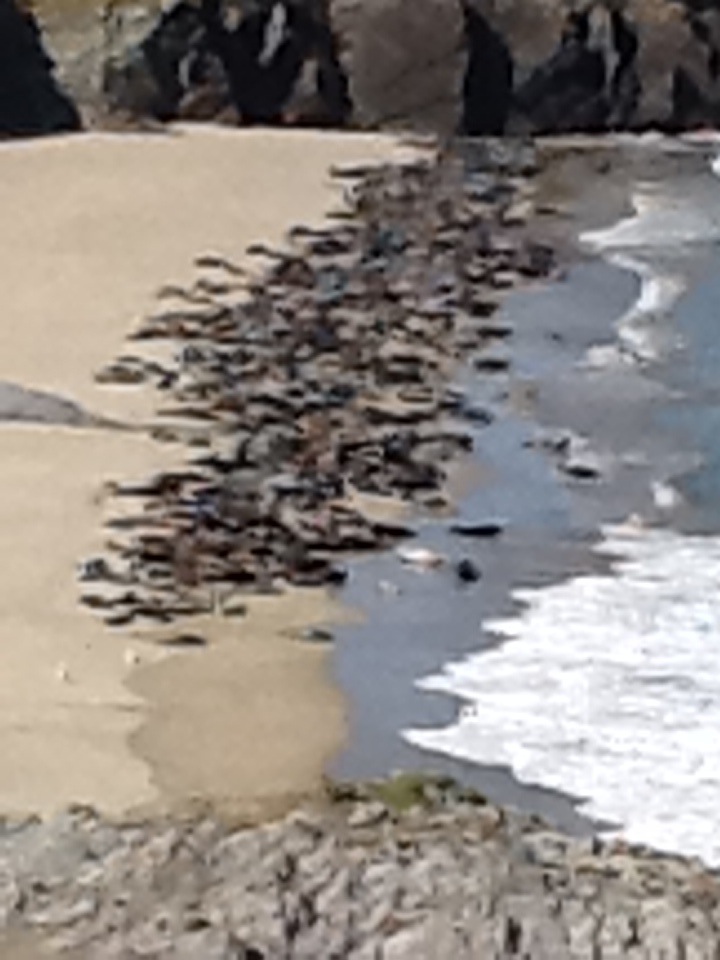
The trip back went somewhat faster and smoother as the boat hugged the coast and was less out in the wind and the swell. And returning to the dock was at high tide, and we were all able to step out of the boat onto the pier.
Getting on to dinner, we stop at the South Pole Inn in Annaskaul, established by Tom Crean (pronounced crane) who was born in the area, went to the South Pole with Scott and survived. So there is a very good local beer bearing his name, and in the pub we are fed fish and chips, or lamb stew, all quite tasty after our seafaring adventure.
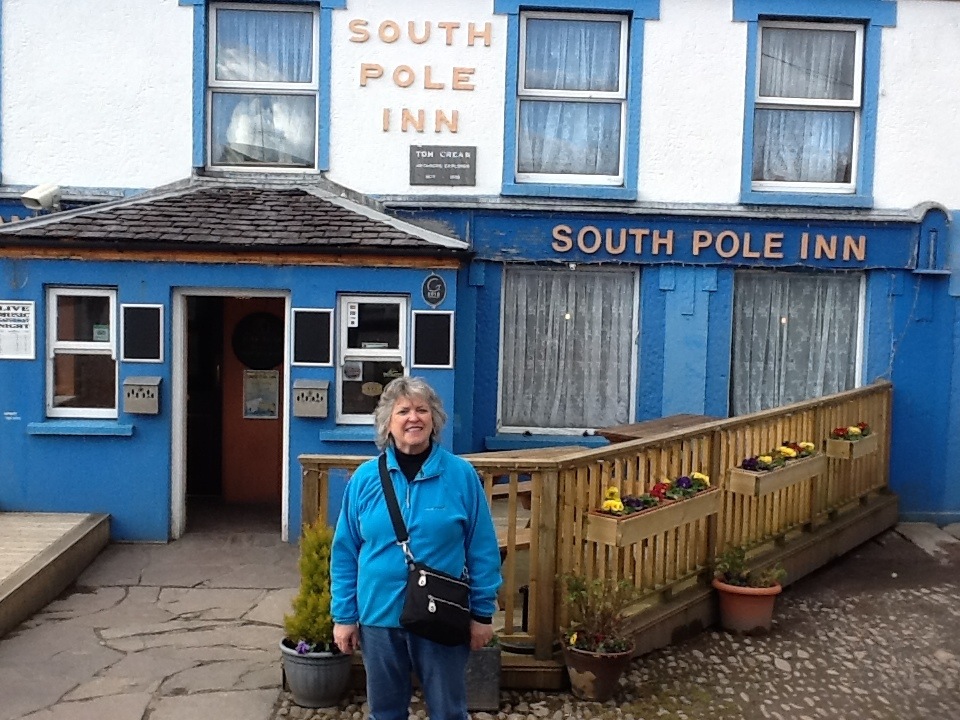
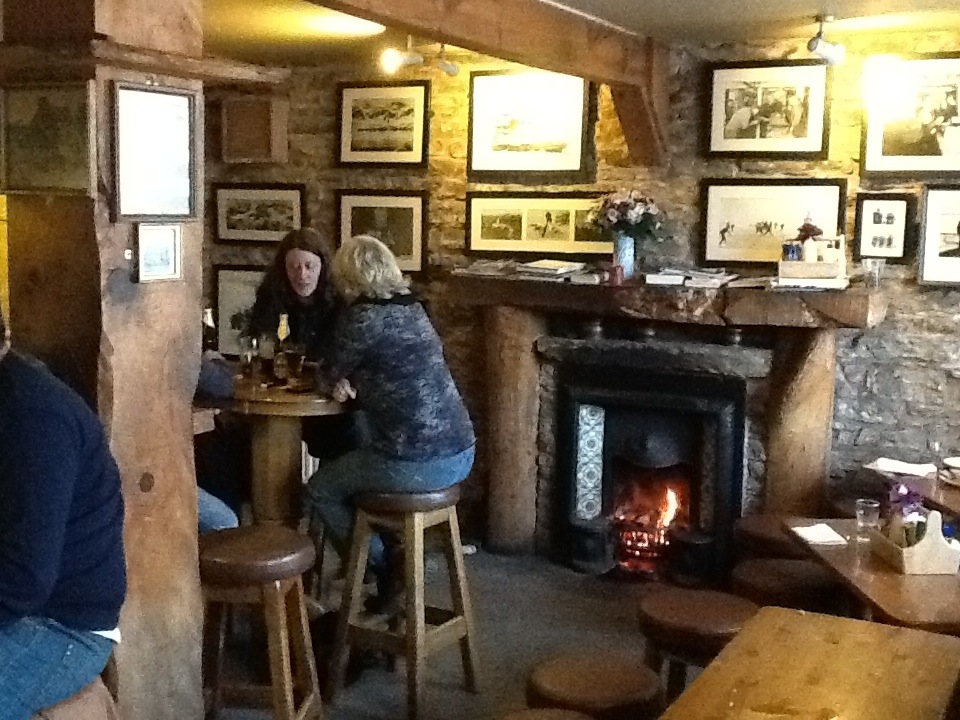
After dinner the boys and others play some tunes in the pub, and the owner spontaneously returns the favor with a song about courting a girl from three miles from Annaskaul. It’s worth commenting that wherever the group plays, locals and other travelers pull up stools, listen, sing along, play along if they have instruments, and offer their own songs.
Back to the hotel, but no concert as such, since it has been a long day and we all have to pack up for the jump to Glengarriff in County Cork. Paula and I do some packing, but feel we owe it to Ken, our friendly hotel bartender, to lengthen our bar tab before closing it out. We are joined by a few others who feel the same.
Another substantial breakfast, and this will be a more leisurely day. Several of us band together to take the road less traveled, meaning we do not join the more serious hikers, who are off on a modest hike of four or five miles into the mountains. Our fearless leaders are with them, and they set off on a short boat ride across the lake to a trail head while we are still breakfasting and the breakfast hour lasts until 11, although we’re back in the room earlier for preparations and some writing.
Our grouplet resolves to gather in the lobby at 11:30 and hike along the path taken the day before by the jaunting cars through the national park. The jaunting cars offered only a few opportunities for photos, and we all want to go through Muckross House, so six of us set out with cameras and good walking shoes to make the 12:40 tour.
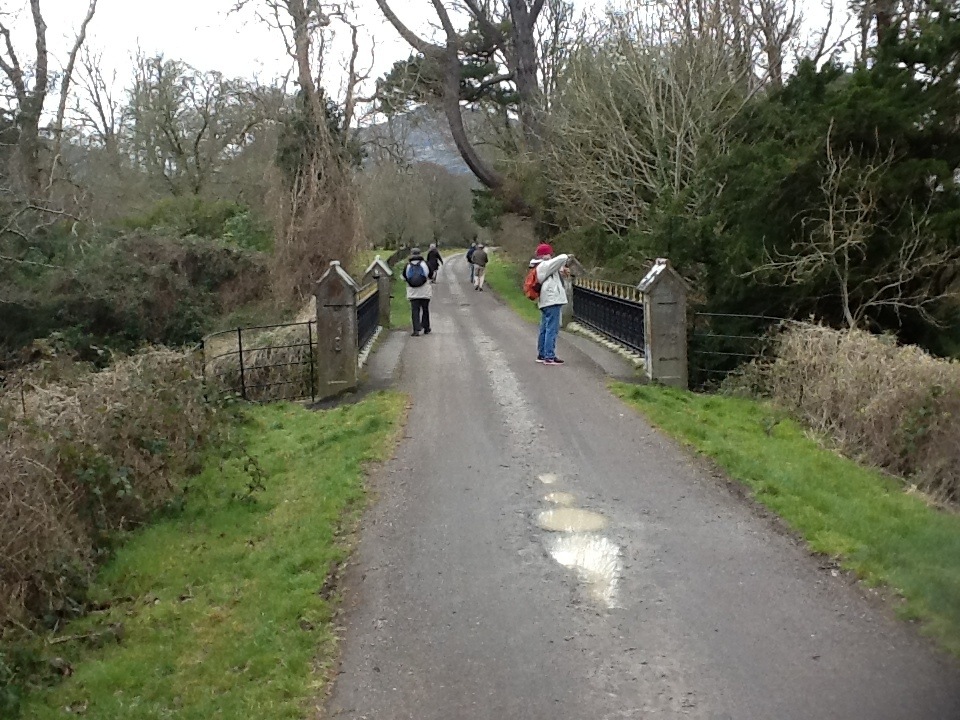

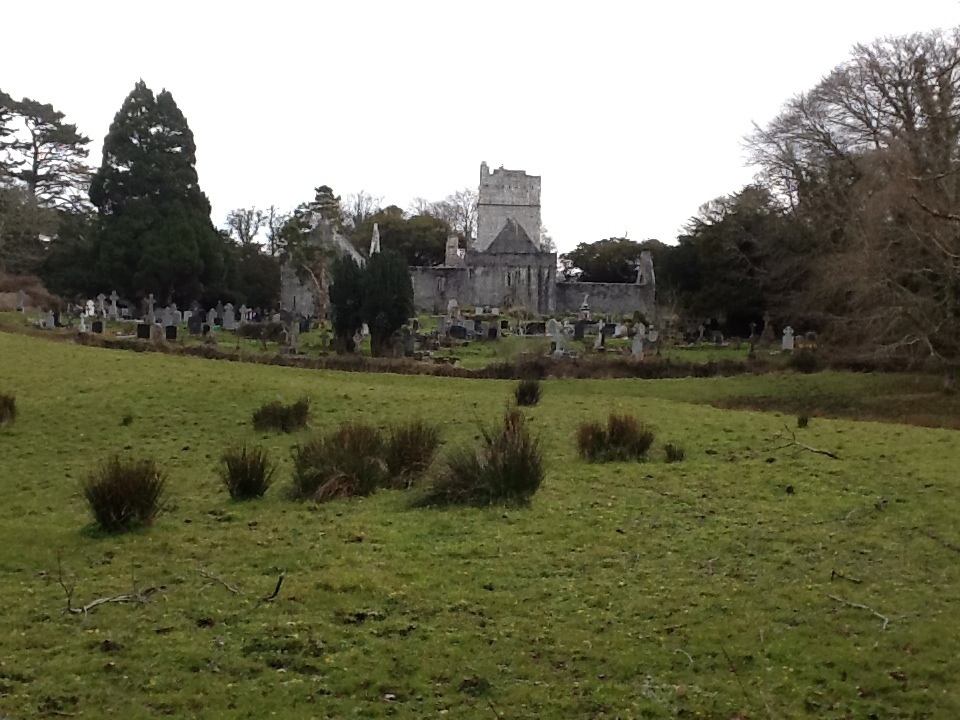
Along the way is Muckross Abbey, sort of an open air place suffering from deferred maintenance.
Muckross House is the ancestral home of the Herbert family, built at the end of the 1700’s. Of the thousands of grand homes built by the titled and wealthy English across Ireland and the UK, about 200 remain, mostly as showplaces. This is one of them. And this was one of many that ran into financial straits, to be bailed out by marriage into American money. The California parents bought the estate as a wedding gift for their daughter, who had fallen for an Irish judge posted to Zanzibar, as a way to lure him and her back to civilization, but on a homeward trip to see her parents, she became ill on the crossing and died in New York. A few years later the parents and the spouse transferred the estate to to the people of Ireland to be a national park.
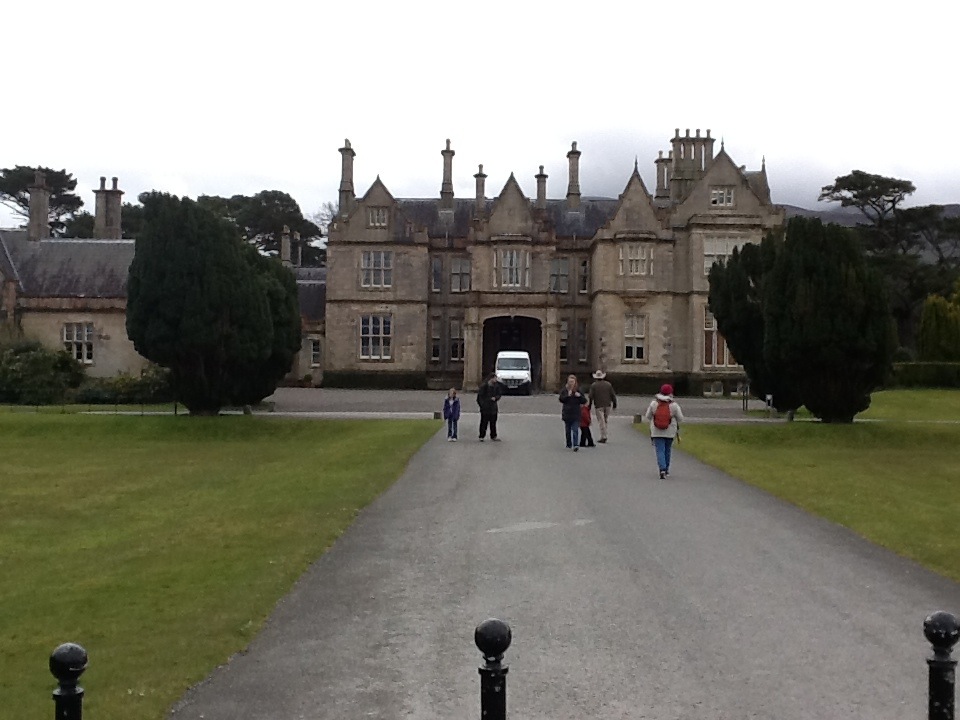
No pictures of the interior allowed, as in most great houses, but we are told that about 70% of the furnishings are original to the house. In 1861, Queen Victoria and Prince Albert made a two night visit to the Herberts, as he was a member of Parliament, and the royals were on a visit to Ireland with 100 of their most indispensable servants, staff and advisors. The Herberts had about six years notice in order to prepare, so a lot of what you see on the ground floor in the house was constructed or purchased for the Queen’s visit, including portraits, decor, furniture, and tableware. A royal visit was a severe strain on the pocketbook. But there was also great pressure to keep things as they were, as Albert died in December of that same year, and the cult of mourning and memory continued for decades.
During the tour, we’re joined by another couple from our group, and there is general agreement that we do not need to prove anything by walking back, and jaunting cars for eight would cost 80 euros, while two cabs would cost about 25 total. So a couple of cabs are called after some confusion about the operation of pay and cell phones. Back to the hotel in time for naps, then cocktails, then dinner. Gathering in the bar, we reconnect with the hikers, who were out for a seven mile hike when all was done, the last two thirds in the rain. But a day without rain in Ireland is like a day without sunshine.
Dinner is followed by music, and we (meaning Jim, accompanied by hysterical laughter by Paula) introduce the group to a happy chorus song.

The morning after the night before. Well, the night before wasn’t particularly late or damp, so getting up was no chore.
Our first activity is a jaunting car adventure. Several jaunting cars will come to the hotel front door, pick up the group, drive us through the national park to Muckross House and drop us at the Muckross boat house, where several boats will take us out on the chain of three lakes and back to the Hotel. the carts take either four or six people, and are either two or four wheeled conveyances, pulled by patient Irish Cob horses. The Irish Cob seems to be a smaller and sturdy draft horse. If you’ve seen the John Wayne – Maureen O”Hara movie, The Quiet Man, you’ve seen a jaunting car, except these all have inward-facing benches, with a roof and roll-down clear vinyl sides, to protect us from wind or rain.

The trip through the national park is over a dedicated, no-motor drive, so we encounter pedestrians and bicylists, but no ATV’s or cars. We’re in a four-wheel type driven by Gerard and pulled by Sally. Sally has an every-other-day work schedule, and has a good idea of what she’e there for, pulling off the track and turning to afford good camera angles. On the other hand, she also has a good sense of when it’s time to travel on, sometimes before the slower humans have gotten out their cameras and fiddled with all the settings on them.
Along the way, Gerard talks about local history, the establishment of the national park, the plants and trees, and points out a flowering tree already in full blossom despite the late spring, and when someone identifies it as a dogwood, he says no, it’s the wild Irish rose, which pronouncement is inevitably followed by someone saying that we’ve heard that it’s the sweetest flower that grows. Ha!
He points out massive yew trees, which can grow for a thousand years, albeit extremely slowly, but were much decimated by the need for the trunk wood which was famously tough and springy, well suited for the medieval longbow. Rhododendrons are weeds in the forest, and grow thick and vinelike on the forest floor, covering the ground and interfering with regrowth. And as damp and shaded as the forest floor is, moss and ivy simply cover the trunks of the trees to great heights, at least until the canopy begins.

The jaunting cars drop us at the Muckross Lake boathouse, where four open fishing boats take 10-12 passengers each out for the lake tour. This would be extremely pleasant in June or July, and brisk in May. In this April, however, it is rather a trial, particularly for our California travelers. It’s not misty, nor is it rough, but it’s in the forties with a brisk headwind on a chain of three very open lakes, and the ride is about an hour. The boatman keeps up a pretty good chatter and string of jokes, primarily husband and wife jokes — e.g., in Ireland, wife is an acronym for washing, ironing, feeding and etcetera. He apologises for the headwind on the last and largest lake, which is Loch Leane where our hotel is situated. We actually dock at a landing at the foot of the ruin, but by that time we are sufficiently chilled that exploring the ruin is not as high on the agenda as a bathroom visit and a nice hot cuppa. We still don’t know about the ruin.
We have been told by James that the jaunting car and boat tour will take from 9 to 10, so of course we’re back at the hotel at 10:40, with twenty minutes before the bus will take us into Killarney. The troops rebel in fine American style, and the departure is pushed back to 11:30, time for a bathroom break and whatever else is required.
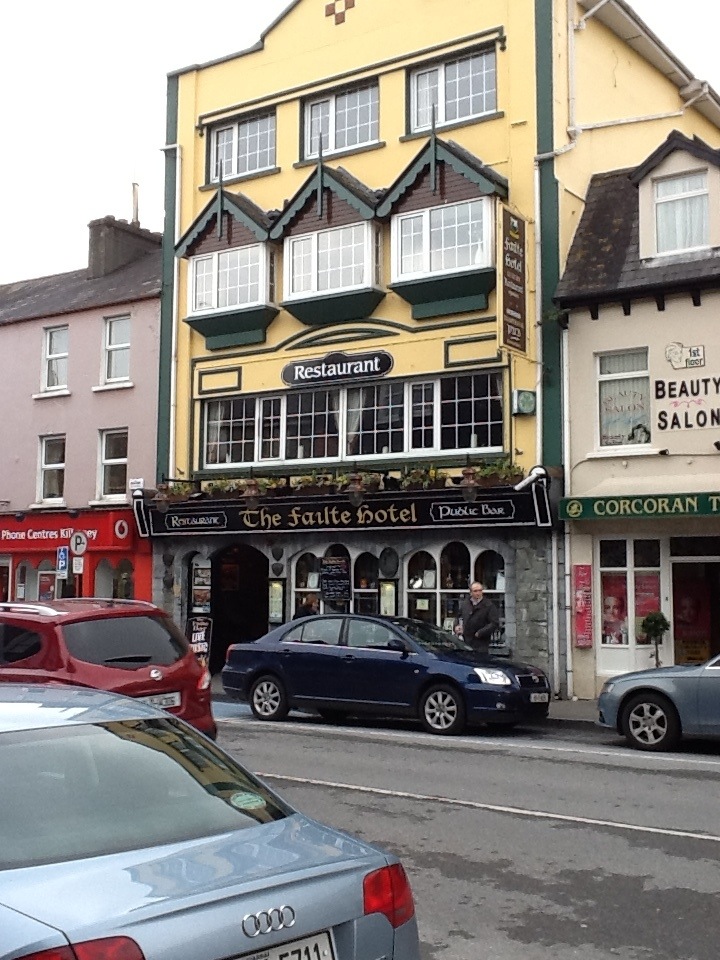
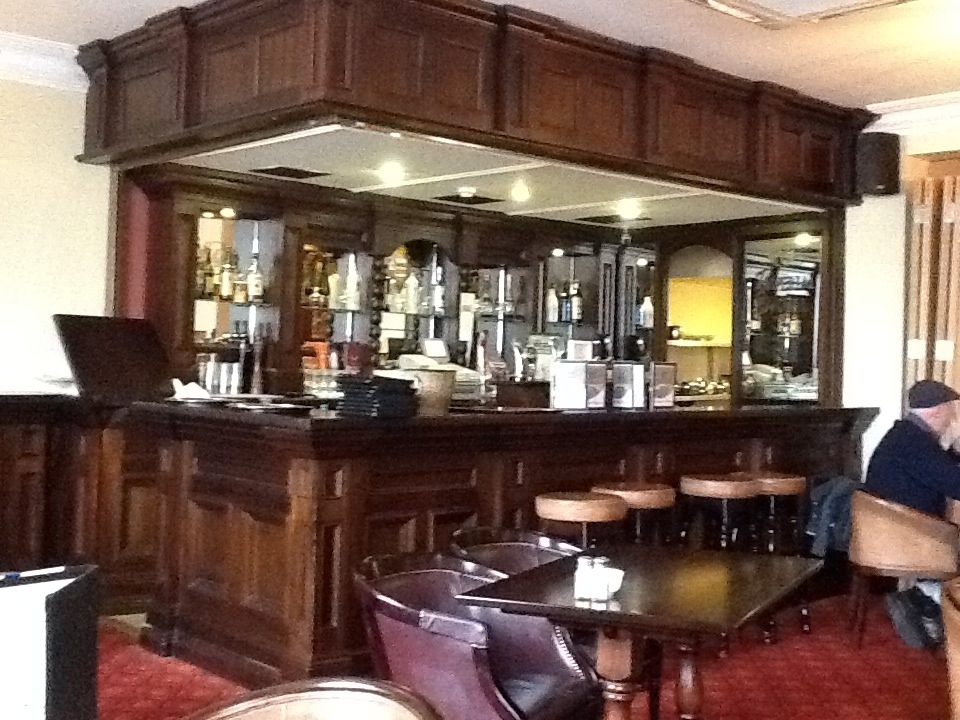
The trip into Killarney is set for four hours, for lunch and shopping. Paula and I set out down the street in search of some pub food. I am still looking for some beef and Guinness pie, and we turn in at the Failte (pronounced falche, meaning welcome) Hotel’s pub, winner of a James Joyce award for authenticity. We are requested to bring back pictures of pubs by a local Wausau pub owner, perhaps for decorating ideas. This one’s a good one. Dark wood, low paneled ceiling, with walls and ceiling covered with rugby team jerseys, banners, Guinness decorations, local political characters, and authentic locals eyeing us as unusual in this off season. The beer is as good as ever, and the food is wonderful, Paula waxing ecstatic over a chicken and garlic penne pasta dish, and myself very pleased with my beef and Guinness pie, which is actually a stew of beef, carrots, onions, and potatoes with a little cap of puff pastry on top. No pictures of the food, but here’s the pub.
Three thirty is bus time, again time to go back, rest or blog, and get ready for the evening. Frustrating that the wi-fi still doesn’t work.

Dinner in the dining room involves pork cutlets, hake, or a vegetarian selection, but promises sticky toffee pudding for dessert. Now sticky toffee pudding is a very Brit thing, but we have enjoyed it in Scotland and Wales, but Ireland as well, which just goes to demonstrate Irish tolerance. Properly made, it involves a sponge cake with dates, slathered with caramel sauce, and topped with either whipped or ice cream. This meal is rather a disappointment in main course and dessert, however, as the pork is rather overdone, although the apple confit is very nice and the vegetables are delicious, especially the mashed turnips. The STP is worth a sigh and a maybe-next-time, because the cake is closer to fruit cake, the caramel sauce is scant where it should be a swimming pool and lacks butter. But we are not downcast, for we’re in Ireland!
Concert after dinner, about an hour, and the a smaller group retires to the bar.
And then to one of the smaller drawing rooms for music, which continues until well after we have gone to bed.
 travelntrouble