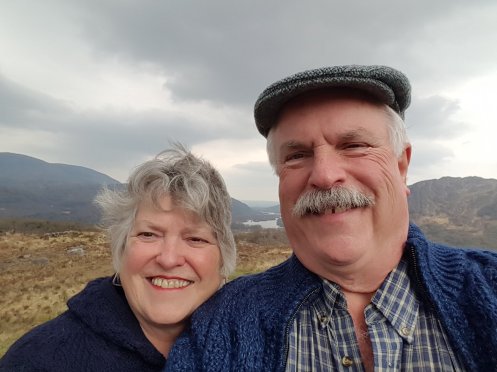
Each time that we have come to Ireland, the tour has begun and ended at the Park Inn Hotel across the parking lot from the Shannon Airport. We’re greeted as old friends when we arrive, and we like to brag quietly that we’re known in pubs on two continents.
The end of the tour involves a final dinner, delicious as always, and a concert afterwards featuring the guys, but headlined by Andrew Unsmiling, a button box virtuoso, Mark Eye Candy on fiddle, and Brendan Wild Hair on guitar and vocals. It’s an evening of trad jigs, reels, hornpipes, and a few vocals thrown in.
This has been our ninth Ireland tour with the guys, and while some of the tours have been repeats, there have always been enough new features to make it interesting. This has been a very convivial group; no-one in the group that we wouldn’t care to tour with again. Considering the number of repeats, it’s likely. And the concert on the last night is equally so, and the musical talent up front is merrier than ever, so much so that even Andrew is seen to crack a slight smile.
The evening ends and the group does goodbyes, hugs, exchange of travel plans in the next few days. We have everyone’s addresses and email addresses thanks to the pre-tour bios, a distinctive feature of these tours.
Saturday morning breakfast is covered, and passing through the halls are tour members headed for the airport or the bus stop, or the car rental center, some to fly back directly, others to take some extra time. We’ll hit the bus to Limerick, train to Limerick Junction and Dublin, taxi to the Hilton at Dublin Airport, and fly to Chicago.
Flight to Chicago is quite bouncy over the Atlantic and Canada and arrival is delayed due to a wet spring snowstorm in Chicago area that forces cancellation of many flights to the east and southeast, gate congestion, backups on the taxiways, and our plane circles in a bouncy holding pattern over Lake Michigan. Paula is not amused.
The other distinctive feature is the focus on regions: the hotel stays are either 4+4 or 3+5 and the start and end nights. Daytrips and short hops, a relaxed schedule, no bags in the hall every morning at 7 AM, usually enough time in place, and the local contacts, The regional focus permits this. And repeated tours allow you the luxury of going back to explore or experience something that piqued your curiousity before. And as James Keigher points out, the tours allow/encourage/require them and the group to look/see/digest aspects of their home countries that they would not if they lived here.
We are happy to promote and proselytize for Men of Worth. More than once on any tour, we hear people on any of the tours say, “You wouldn’t see this on a (name of tour operator) tour.” Add to that the focus on music by the leaders, group members, and local folks. Add to that the genuine happiness of the hotel staffs to see the group returning. One hotel on one of the tours allows only one tour, MoW, to book a multi-night group. The places know they will get a good return on food, bar, and lodging, as well as careful and protective leaders and a convivial group. All in all, another tour most satisfactory.
Thank you, James, Donnie, Bronagh, Phyllis, and Men of Worth Escorted Vacation Tours.
This is our last day. The bus takes off from the hotel at 10:30 after we settle up our accounts for any lunches, laundry, beverages, or other incidentals. We will make our way back to Shannon Airport, our dispersal point, but first we have a lunch and a cruise.
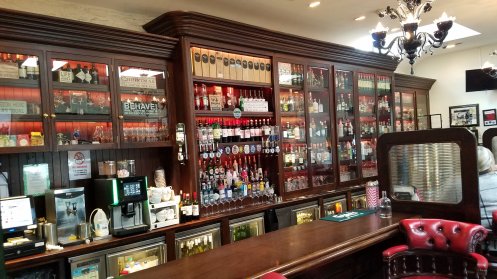
We stop at Killaloe on the Shannon River, where we eat a tour-provided lunch at Flanagans, located by the river.


We eat in their round tower area. Picture of their bar.
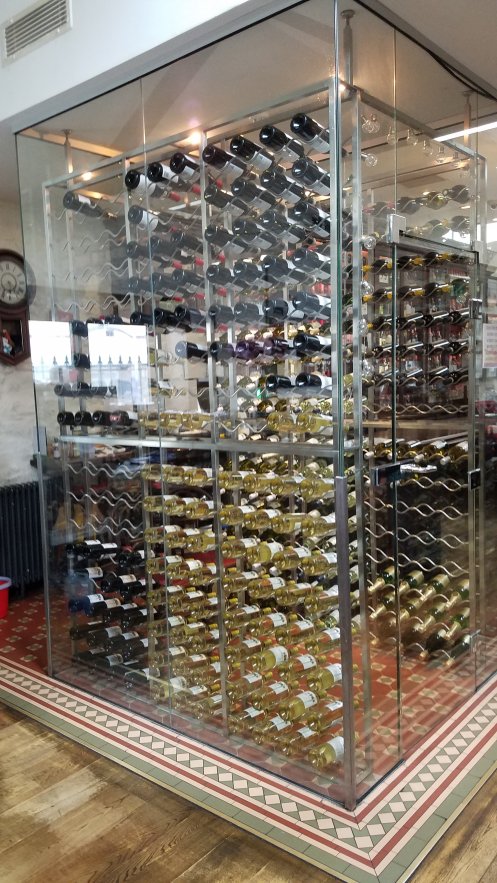
And immediately to the left of the bar, their wine cellar/safe.

After the lunch, we have but to cross a small lawn to an embarkation dock to the ship for our cruise.

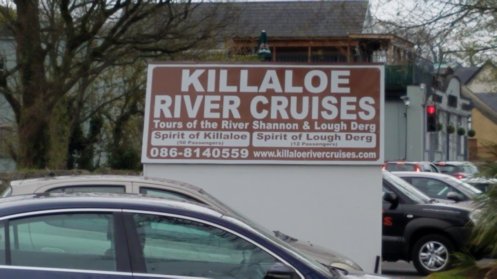
The ship fits us all inside, but some prefer the upper outside deck. The cruise offers Irish Coffee according to the “original” recipe: a measure of Irish whiskey, two lumps of demerara sugar stirred into hot, strong coffee, with lightly (barely) whipped heavy cream floated on top. They don’t actually whip it, they half-fill a pint bottle, cap it, and shake it vigorously for about a minute. They serve other adult beverages too, but the Irish coffee is pleasant on a cool and breezy cruise. And we’re not sure if the cream comes from County Clare or County Kerry cows, but it has an incredibly high butterfat content/taste and is enough to float a small raft on. We limit ourselves to two.
Lough Durg is part of the Shannon River, with homes, hotels, and marinas along its shores. It’s quiet, but the river is wide enough to kick up some rough waves in a good wind. It’s a calm day on this part of the lake, and Paula is allowed to step into the wheelhouse and drive for a bit.

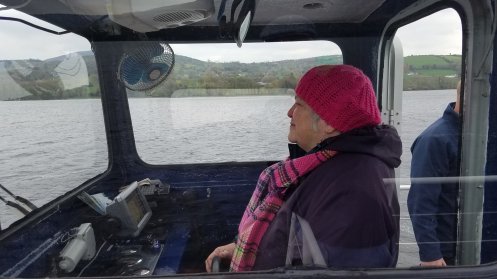
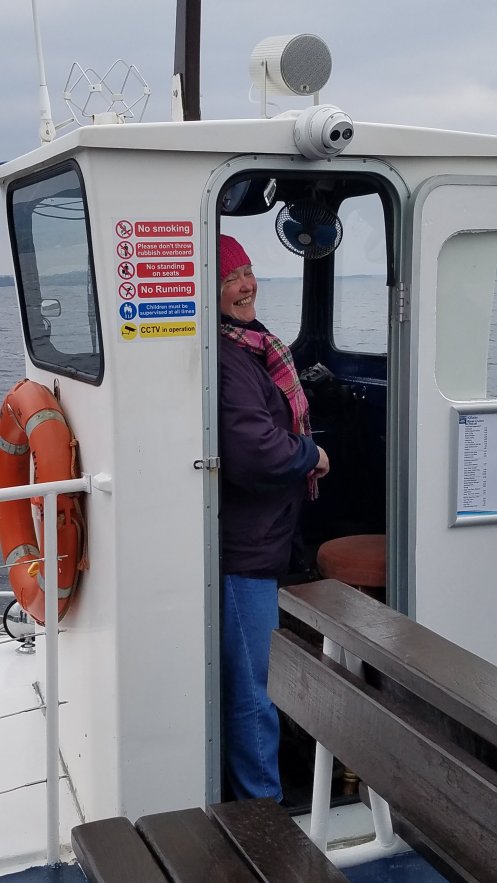
The ship, Spirit of Killaloe, is larger than it was several years ago. It was taken into dry dock, cut across the middle, four feet added along with a new stern and drive plant, and welded back together. Pix from Facebook.

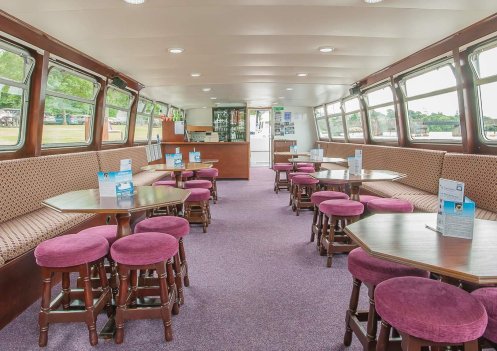
And after the cruise, it’s back on the bus for a snoozy, short drive to Shannon.
At 10 we leave for a trip around the Ring of Kerry with a couple of significant stops.
First is essentially a choice between two ring forts.
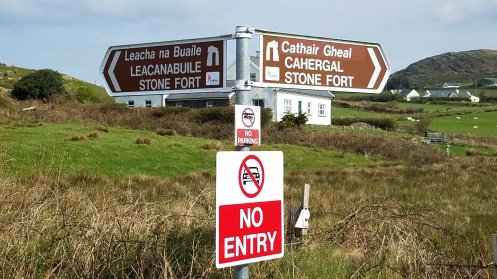
These are residential and defensive structures built on two nearby hills in prehistoric times, maybe in the the third or fourth century for a local lord or chieftain. You can visit both, given enough time and climbing energy. While there is an asphalt path that winds around each hill, it is a little steep and hard on the hip. Not as hard as for prehistoric tribal raiders, though. As they didn’t have a OPW walkway, they had to climb a steep, rugged hill.

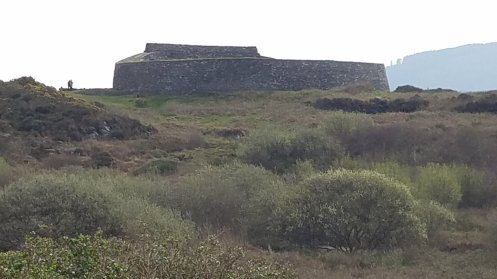
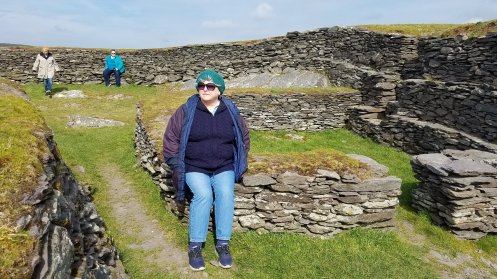
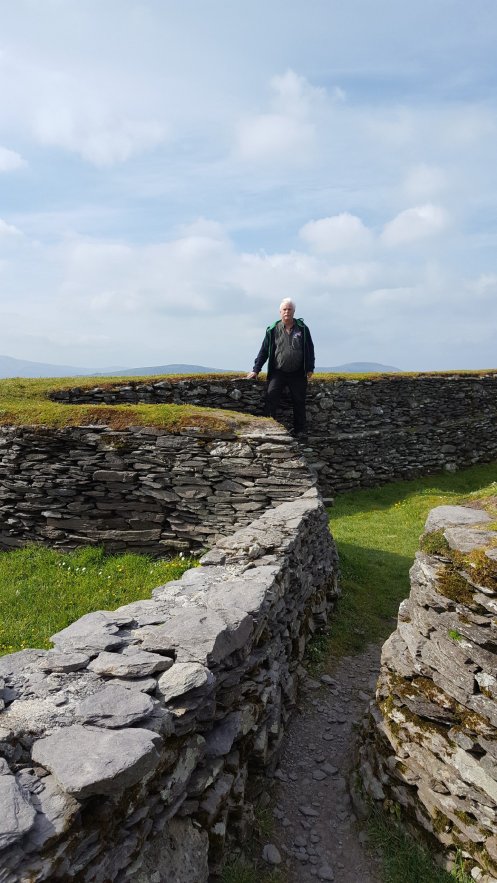
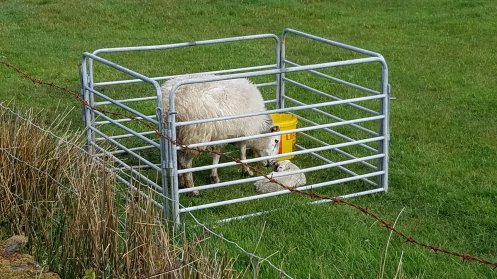
We have time to visit one fort. Part of the trip up is getting by a farmer offering to let you hold and photograph a two-week old lamb (Two euros, please) which we pass. Another stopping point on the way up is to admire and photo a ewe and her day-old lamb. The lamb is still resting from the birth and mom keeps nudging her baby.

Across the landscape is a Norman castle ruin, probably 13th century. Beyond that north across the water lies the Dingle peninsula. Both the forts and the castle are located to observe and defend against raiders from the sea.

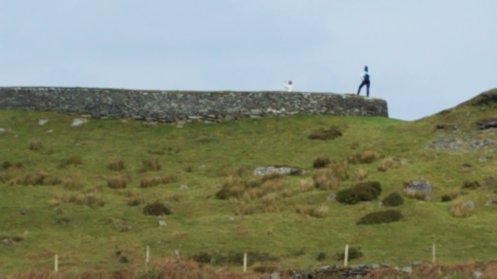
And seen from afar, a picture of Bronagh, one of our leaders, stands atop the fort, posing as Boadicea, warrior queen.
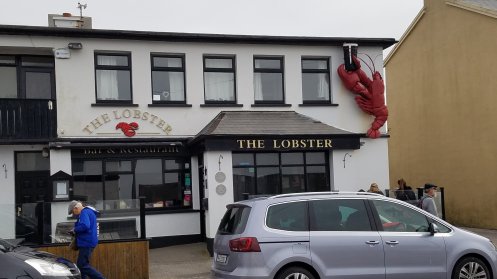
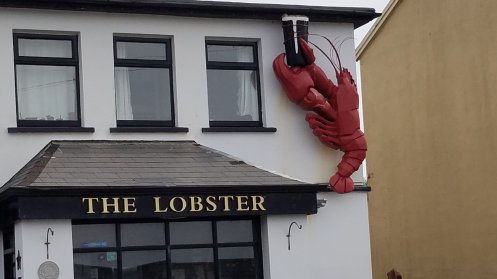
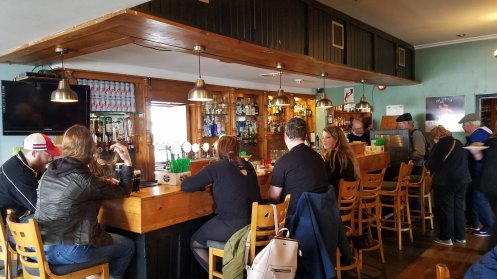
Next is an independent lunch stop in Waterville. We eat at The Lobster, which features a very large crustacean climbing the wall with a pint of Guinness.
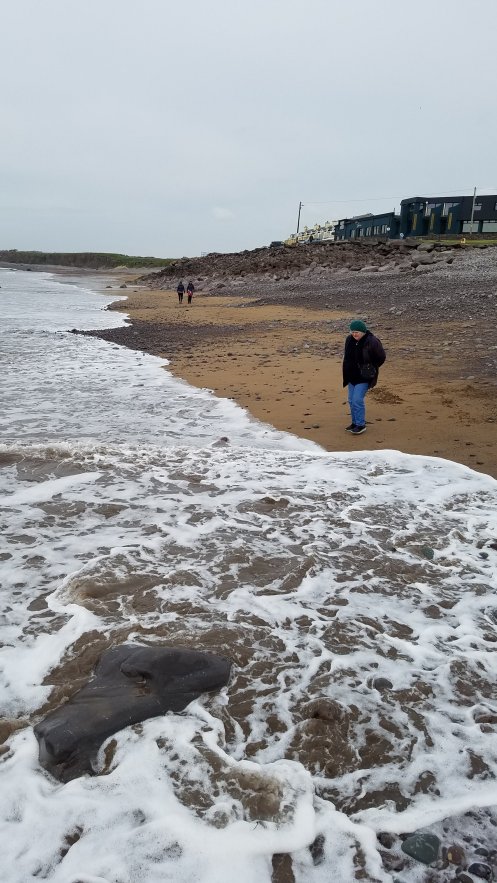
Waterville also affords a walk down to the beach and a game of tag with the surf.
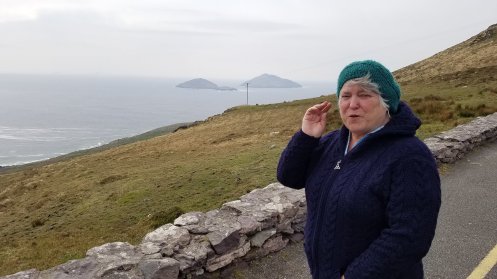
A little farther on we stop at a scenic loookout at the west end of the peninsula
We did this tour eight years ago and one of the days was devoted to the Ring of Kerry. This is an extremely scenic and popular activity, so much that tour buses (and for that matter, heavy goods vehicles, are only allowed to travel in a counter- or anti-clockwise direction. Cars are allowed to drive in either direction, giving you the choice of being stuck behind a bus for miles, or else meeting bus after bus oncoming. Off the west end of the peninsula lie the Skellig Islands, once occupied by monks in stone beehive huts. More recently, they were occupied by Luke Skywalker in exile in the Last Jedi movie.
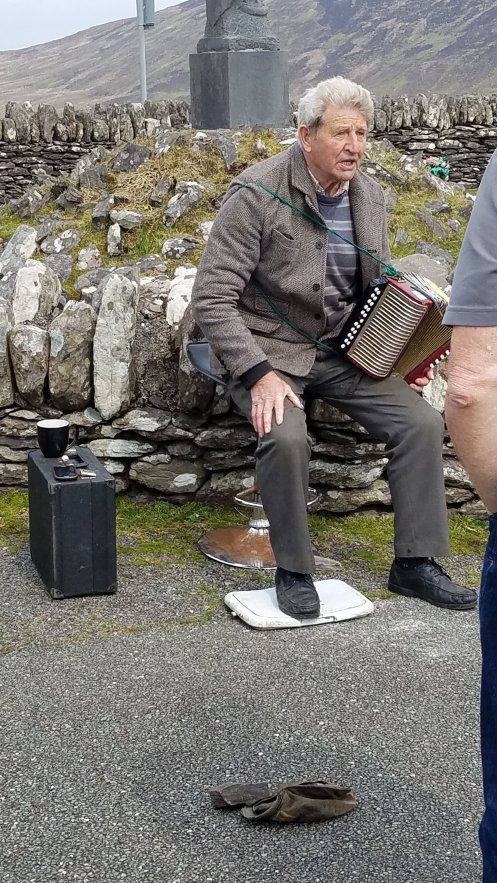
One of the other memorable moments from this earlier trip was stopping when one of our group discovered that she had left her purse, including wallet and passport behind in a public restroom at the beginning of the Ring. At about the same time, one of the MoW leaders got a call from the gift shop next to the toilet facility, to the effect that a German tourist had found the purse, turned it in, and through quick sleuthing, the shop owner had acquired the cellphone number. At this scenic pullout on the Ring, James asked a fellow, who had a large dog and was playing his button box accordion for small donations, if James could pay him to drive back to the shop to retrieve the purse. The fellow agreed, drove James back and returned, and requested a sing-along tune (the only one he knew to sing) along the way that James dutifully led, accompanied by the very large and very friendly singing dog. This tale is all by way of relating that the bus this time stopped at the same scenic pullout, occupied by the same button box player, who recalled the event of eight years past, and launched into the same song on his button box. No singing dog this time, as he had died last year.
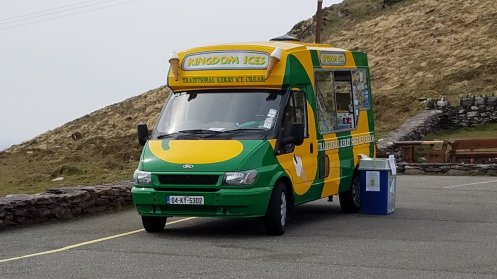
There is scenery and ice cream on offer as well.
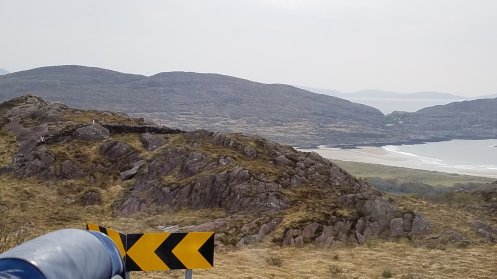
On our way back along the southern coast of the Kerry Peinsula, we stop at the former home of Daniel O’Connell, the Emancipator. His claim to fame is the wresting of some elements of Home Rule for Ireland away from British Parliament, and even more, the repeal of British laws that forbade Roman Catholics from holding any local, regional, national, or parliamentary office. The home is now operated by the national OPW, and while a few of the group enter the house (5 euros) others ramble the grounds, the strand, the gardens, and the fairy walk.
After that, no more stops and we head back to the hotel, nap, and dinner, with a MoW concert.
The concert begins with Paula and Jim presenting a cutting of a short play about Grace Gifford Plunkett, the tragic bride of Kilmainham Gaol, in the aftermath of the 1916 Easter Rising, followed by the more recently composed song about her and Joseph Plunkett sung by James. The play deals with her incarceration for political activity seven years afterward, along with her description of the wedding in the prison chapel hours before Joseph’s execution. Several teary reactions in the group.
Back from Tralee, we do a quick nap (another salient feature of these tours, time for a nap) and dinner. Then we board the bus for a short drive into town for a visit to and concert by the Killarney School of Irish Music.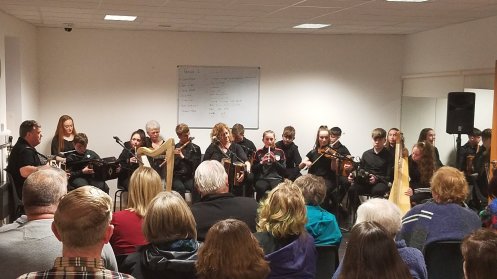 The students there begin with penny whistle and go on to learn their choice(s) of fiddle, flute, guitar, harp, banjo, concertina, bodhran (hand drum), uillan pipes, button box, and voice. This provides for an ongoing diaspora of pub seisún players and singers for the future.We’re treated to an hour concert of trad music, including two accompanied vocals, Isle of Hope, Isle of Tears, and Caledonia, two of our favorites, and an instrumental Josephine’s Waltz. Waltzes are not a big thing in trad, and according to the leader, what’s there is either a slowed-down jig or else stolen from Scandinavia.
The bus drops us near the tourist information office, and it’s a five minute walk into the high street for shopping, gawking, and lunch opportunities. Lunch for us.
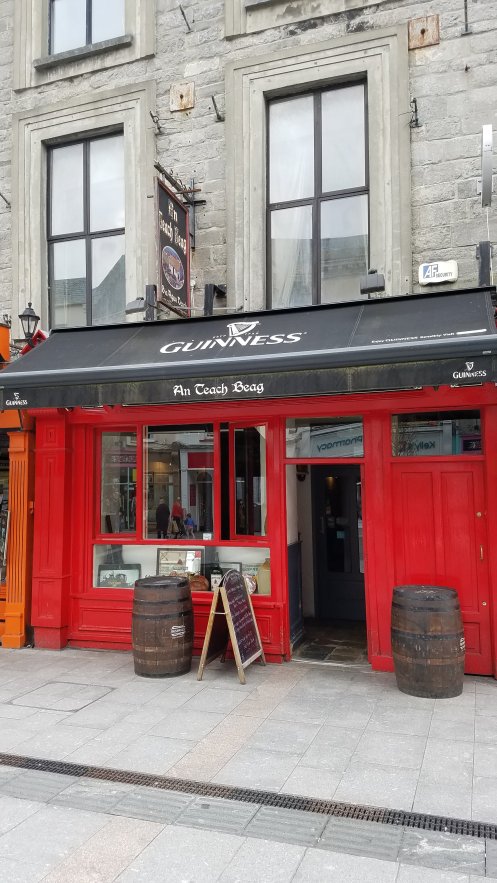

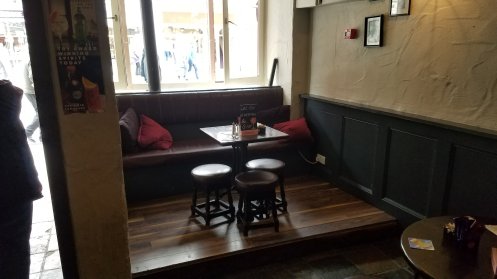
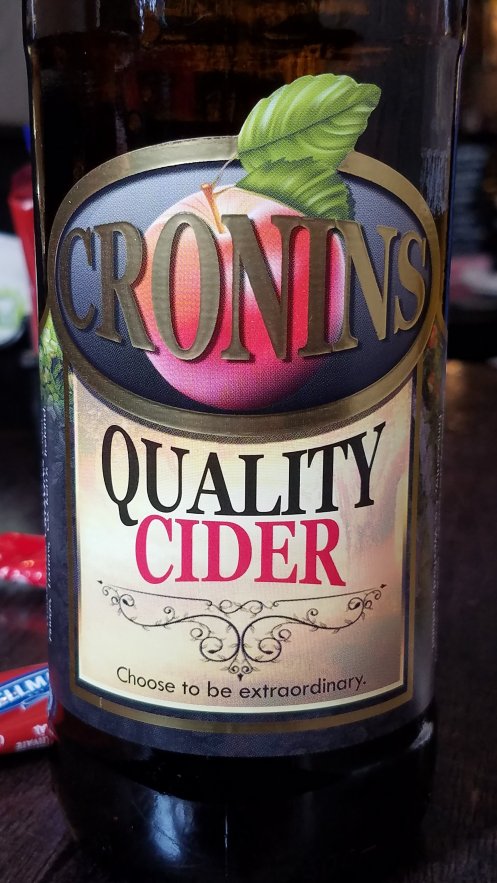
Cider is indeed an alcohol (4.5-6%) apple drink, slightly sparkling but not foamy, and is a staple in every pub. Ciders range from sweet to dry. Most pubs carry several brands, whether in pint bottles or on the tap. The most prevalent is Bulmers, rebranded Magners in Northern Ireland and the US. Cronins is a regional brand in Kerry, and is one of many brews. There are periodic listings in newspapers or magazines of the ten or twenty best Irish ciders. They go very well with fish and chips.
Wandering in Tralee.
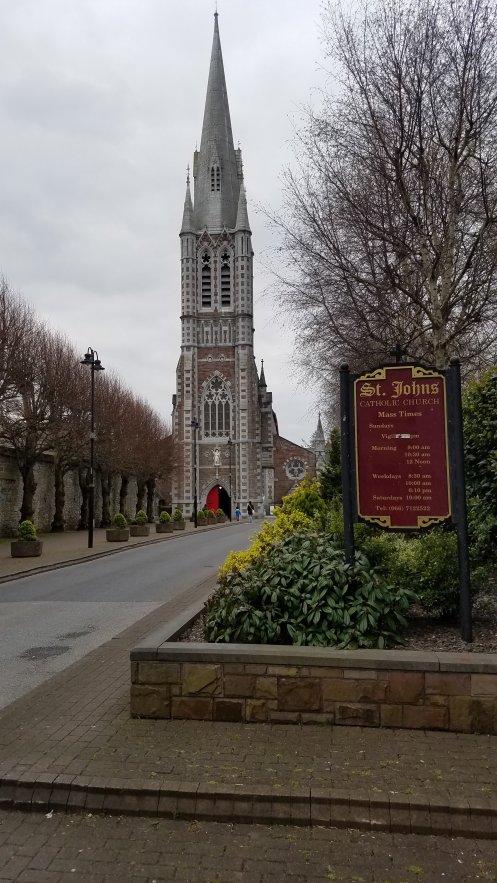
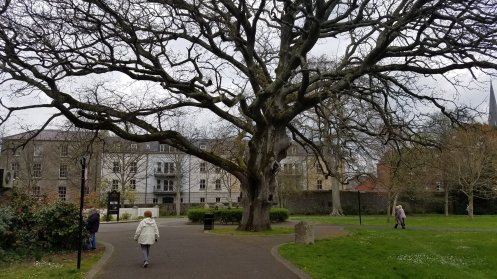
On the way back to the bus we wander into the Tralee Rose Park, where exhibitors and nurseries plant their best roses for the annual Rose of Tralee Festival.0

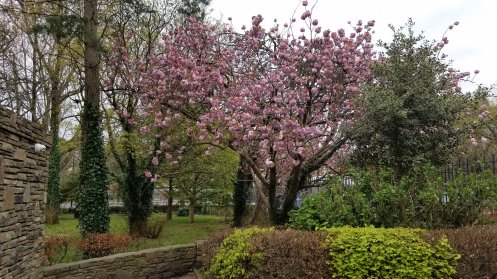
In the center of the park is a Rose of Tralee sculpture.
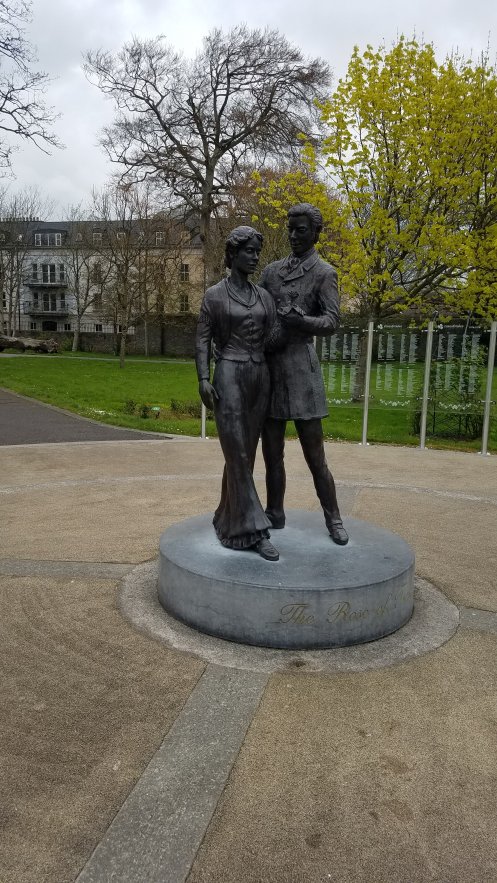
And around the circle are glass panels naming the award-winning growers and exhibitors. Panoramic photo.

My Rose of Tralee.

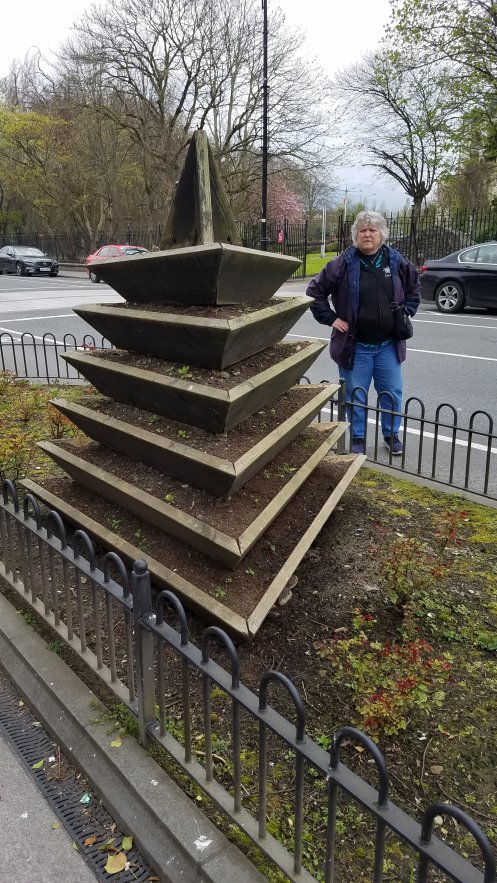
Outside the park and elsewhere in Tralee there are these planters that my Rose in Tralee wants for our back yard. Or front yard.
While we were in proximity to another group of Wausau/Wisconsin folks in Killarney, schedules unfortunately didn’t permit cross-pollination. While we were jaunting and cruising, they were doing the Ring of Kerry, which was on our schedule for Thursday. Too bad.
Our Wednesday trips are to Ardfert Cathedral and then into Tralee for wandering time.
Bus leaves at 10 AM, another relaxed start. On Niall Huggard’s suggestion at the hotel, our first stop is Ardfert Cathedral. It is a ruin, and the site of several churches and cathedrals dating back to the 800’s.
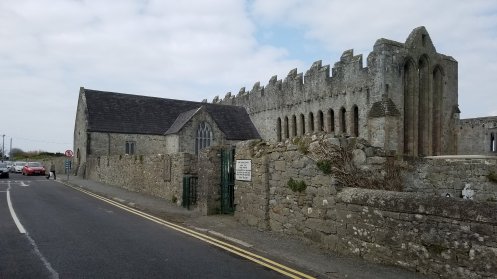


The stonework and the church chronicles show evidence of a 10th century rebuild and a 15th century rebuild.
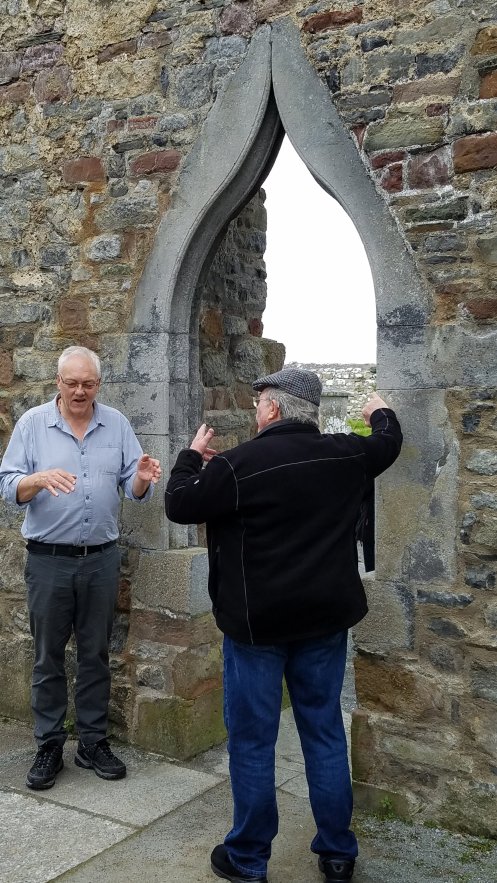
We are led around by a National Office of Public Works guide who explains the details of the building’s history, predecessors, excavations, and nearby temporary churches while rebuildings went forward. He promises time afterwards to take pictures, so please just keep up. Of course he soldiers on at length and there isn’t time. So here are some bootleg pictures.


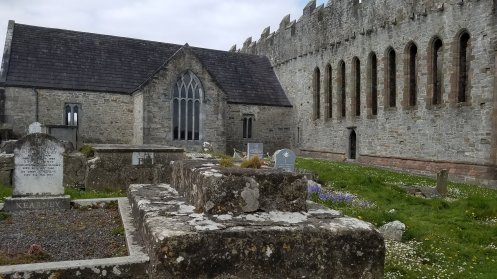
Some of the renovations include crenellated battlements (above), romanesque, gothic, and moorish arches, and carved sandstone moldings.

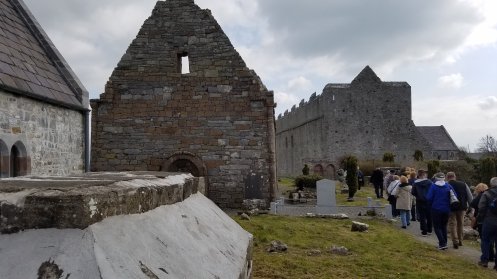
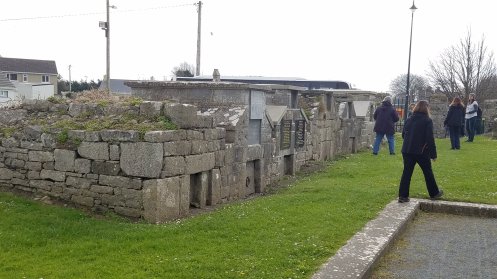
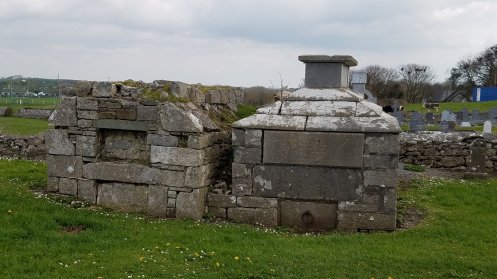
In the church and in the churchyard are old and newer burials and above-ground tombs, some in better state than others.
Time to move on to Tralee.
The hotel is a little over 106 years old, operated by the Huggard family all the while. It has been through several generations, regenerations, additions and renovations. Our group has mostly been accommodated in the newest wing. King beds, sitting and dressing areas, jet tub and separate shower.

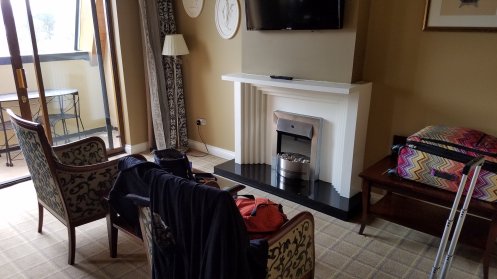


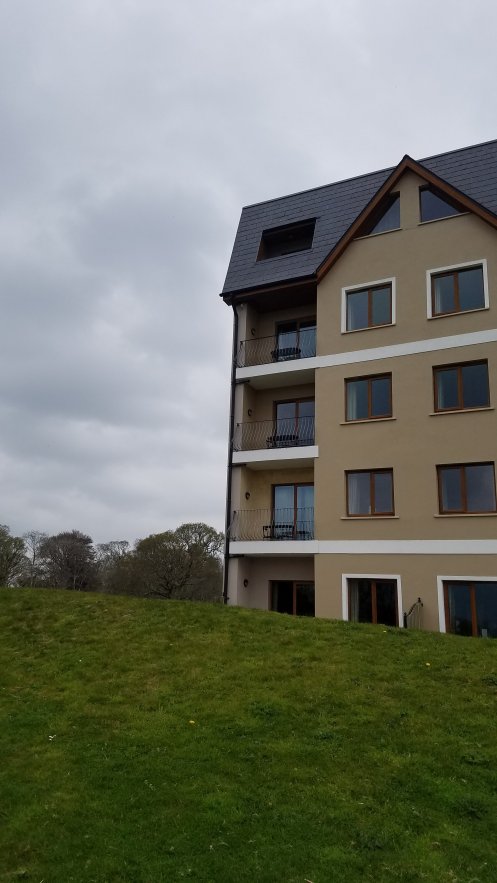

All the rooms in the new section face the lake and the ruin.


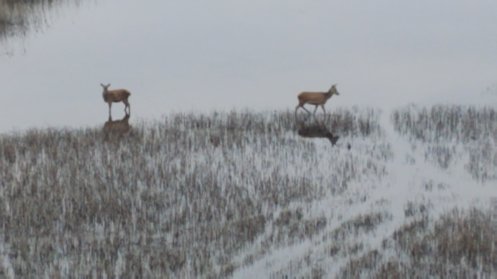
And early morning, we see red deer, swans, ducks, and an occasional heron wandering through the reeds.
The place is host to the MoW Cork/Killarney tours every two years and does a bang-up job in accommodations, meals, amenities, and concierge assistance. The hotel and the surroundings are some of the best reasons for repeating the tour.
Following our jaunting car adventure, and Molly’s final halt at the boathouse, our group boarded several large open boats for a cruise on the middle and lower lough (pronounced loch). Maximum occupancy 12, and we split into groups of 10.
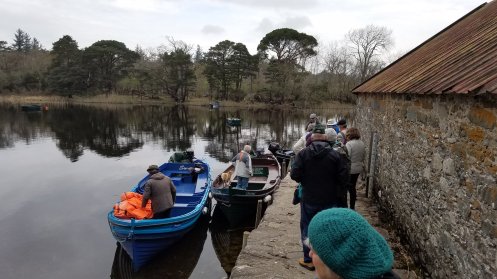
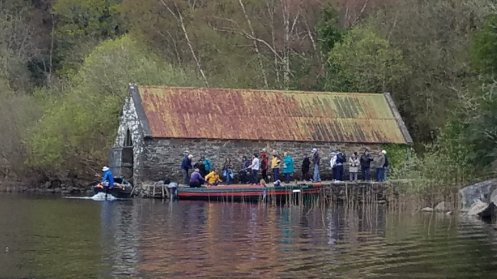
Lough Leane translates to loch of learning, connected to a middle age monastery located on the island Innisfallen in the lough. It was started in the 700’s and operated for about 950 years until Elizabeth I had them kicked out. The monastery ran an educational facility to which young men were sent from all over Europe, including High King Brian Boru.
Brian figures in all kinds of history and legends including Viking sagas,, and is said to have driven out the Vikings from Ireland. Not exactly true, because aside from pillaging, the Norse raiders also established settlements, intermarried over generations, and some fought in Brian’s army and were educated in the Irish monasteries.
The lake is just about mirror calm, and the skies are cloudy.
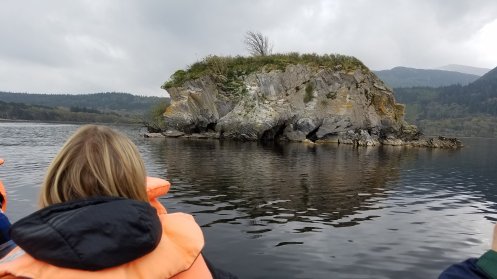
Waves have carved the limestone at the water level.
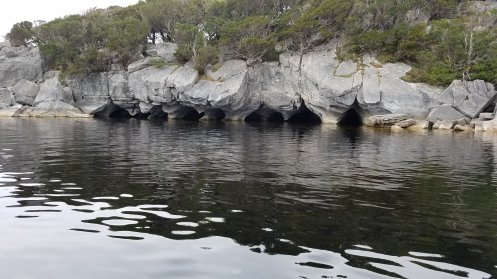
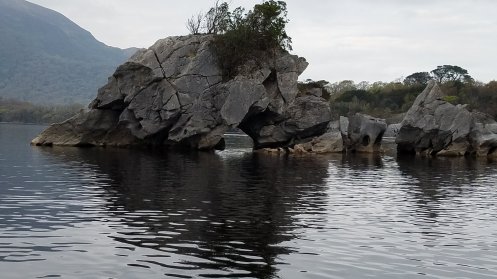
This is the boundary between the middle lake and the much larger lower lake.
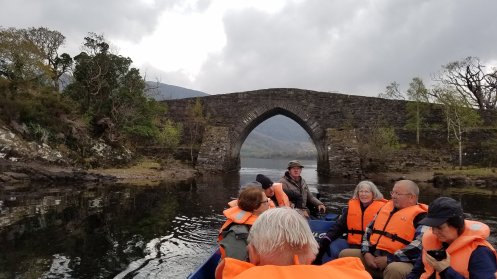
Once onto the lower lake, we can see Carrauntoohil, the highest point in Ireland, all of 3406 feet. Panoramic shot. Carrauntoohil right of center.

Fishing is limited to one salmon per day, but you can catch and keep all the brown trout you want. Atlantic salmon run up through the lakes to the Laune River, and can bring up to 80 euros ($92) each in the wholesale market in Killarney. Commercial fishing would be like netting fish in a barrel. Hardly sporting, you know.
Here’s a view of the hotel from the water. Our room is on the top floor furthest to the left. A good hike with long halls, stairs, and elevators before and after breakfast and dinner.
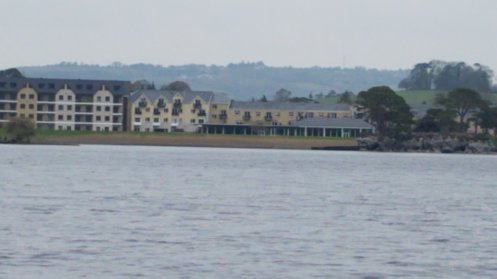

And this is the dock and the ruin of McCarthy Mor’s great house on the hotel property where our boat ride ends.

Tuesday morning is set for a communal ride in several jaunting cars or jarvies through the Killarney National Park up to Muckross house, a grand residence now a museum. The conveyances are wagonettes seating six or seven people drawn by an Irish cob horse. Unlike the jaunting car driven by Barry Fitzgerald in The Quiet Man, the passengers sit facing inward.
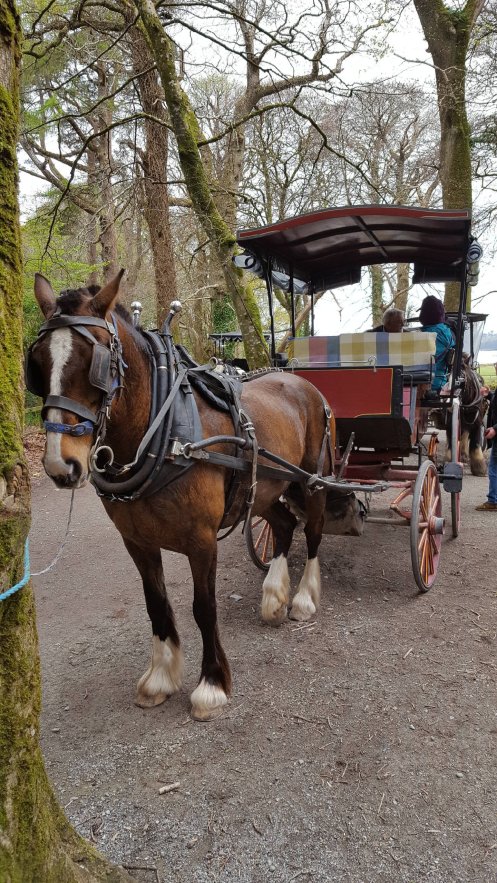


Our horse is named Molly, 16 years old. She works two days a week and is spelled by Julie two days and **** who works 3. Cobs work until they are 26, then retire and generally live until they’re 32. Our driver says she loves the work and attention and knows the routes so well, if she could handle the tips, he could stay home. Cobs are distinguished by their smaller size, their hairy fetlocks, and their strength and endurance. On the other hand, walking and pulling on hard surfaces is hard on their knees, so they need the days off. The driver is fifth generation in the trade, inherited it from his father who died 12 years ago. Only licensed drivers can operate them, and licenses can only be inherited, cannot be bought or sold. He’s full of chat and information. The park is 11,000 acres. No motor vehicles allowed.Among his gems: Rhododendrons are huge, but considered weeds in the forest. The needles of yew trees poison the earth beneath and are therefore discouraged in a forest. Fallen trees are left to rot for ecological purposes unless they block a path. A few years ago, someone proposed making a sequel to The Quiet Man to be called The Quiet Woman, but it was scrapped when they couldn’t find one. Molly takes us to Torc Waterfall for a stop and photo op.

 After the waterfall, Molly takes us back to the Muckross House boathouse. As our driver gets off to tie her up, she decides to trot away independently, much to the consternation of the passenger riding shotgun. The driver yells “Stand, Molly!” but Molly has other intentions, so he has to trot alongside and jump back onto the front seat as Molly takes us back to a turn-around at the great house, where she turns and takes us back to the boathouse again, stopping this time in the proper orientation.
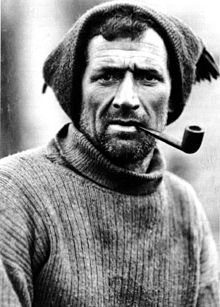
On the way back, we stop at Annascaul, the home town of Tom Crean (pronounced crane). In 1892 Tom ran away from home and joined the British Navy. While stationed in New Zealand, he volunteered to join Scott’s 1901 expedition to explore Antarctica. The Discovery expedition was plagued by poor planning and on-site decisions, but managed to return with only a few casualties.
Tom’s skills and toughness caused Scott to invite him on the 1910-13 Terra Nova expedition to achieve the magnetic and geographic South Poles. While the magnetic pole was achieved, the geographic pole was achieved just 4 days after the Roald Amundsen party achieved it.
Crean was later invited fo join Shackleton’s Endurance expedition in 1914-17. The objective was to cross Antarctica overland. While the objective was not completed, the survival story is pretty hair-raising, and is worth a read, if only in Wikipedia.
Tom returned to Annascaul in 1920, married, declined an invitation to join another Shackleton expedition, and opened a pub which he named the South Pole Inn.
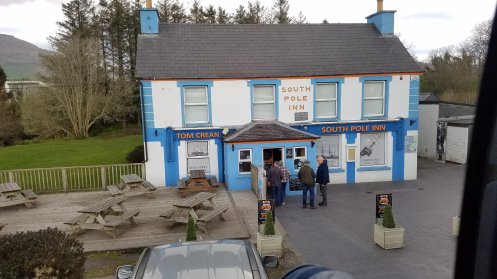
The 1916 Rising had taken place during his absence, the Irish (un)Civil War had started, WW1 had ended, and County Kerry was overwhelmingly Republican. Tom was seen as vaguely suspect, having served in the British Navy. His pub was ransacked by the Black and Tans (under pro-British orders) until they discovered his service in the Navy and left him alone, which made him even more suspect among the locals.
He never told his story, never gave a newspaper interview, lived quietly, and died from consequences of a burst appendix in 1938, pretty much an unsung hero until the last 15 years.
It’s small pub and 47 people make it very, very cozy and slam the kitchen. The fish and chips are indeed excellent, and while we quaff our pints and wine, locals come in for fish and are told “private party.” After dinner, we have some tunes from the boys, and James is asked for the Chicken song, which he dutifully renders to great merriment.
We met a local fellow in the South Pole pub, PJ Callanan, who is a musician, does background music for films, and has been a location scout for films, including the original Once.


Aboard the bus at 10 AM after breakfast and after dropping off laundry at the desk. Laundry will be done and delivered to our room by 6, but we’ll be out until 9 PM. Headed for Dingle peninsula and the Blasket Islands Heritage Center. Dingle and environs are tourist holiday and beach locations. A little cool at this time, so the biggest beach at Inch seems kinda deserted.
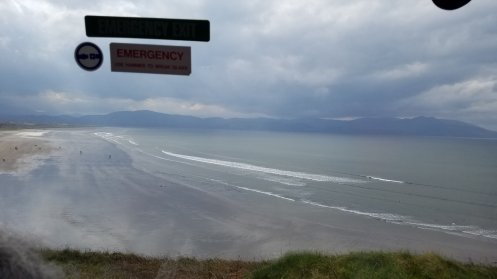

Out here the roads are mighty narrow, but Paul the bus driver is intrepid. Some of the roads are literally carved out of the cliffs with a couple hundred feet drop to the left down to the rocks and the surf — and the bus is driving on the left side of the road, and we’re sitting on the left side of the bus.
We enter the village of Dingle, stop, and everyone out for shopping, photos, ice cream, soup, coffee, a pint, a toilet visit, or whatever else moves you. Ice cream at Murphy’s of Dingle is especially recommended. Don’t eat too much, though, as we’ll be visiting a pub later for the best fish and chips.
Murphy’s is found and proves tasty. Paula gets two scoops, Dingle Sea Salt and Apple Balsamic. James gets Honey Caramel and Apple Balsamic. No pictures, just memories.
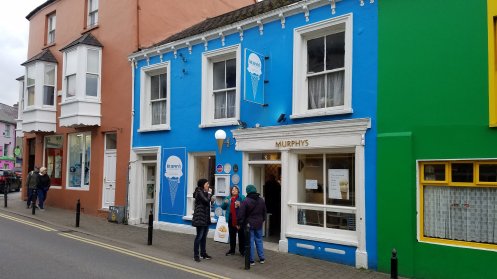
There are other colorful shops and buildings.
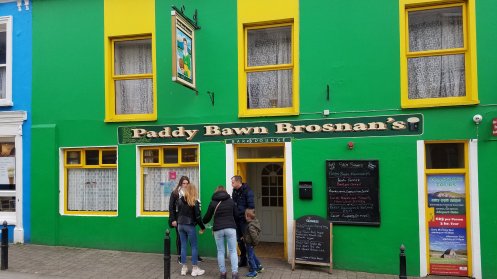

Other shops provide other photographic and retail therapy opportunities, and we enter a pub for wine and a pint of cider.
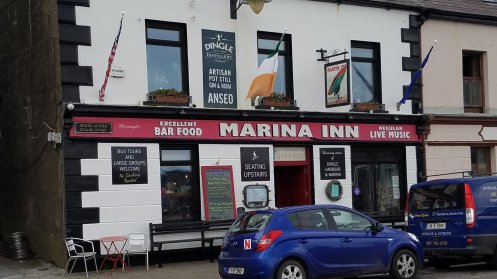
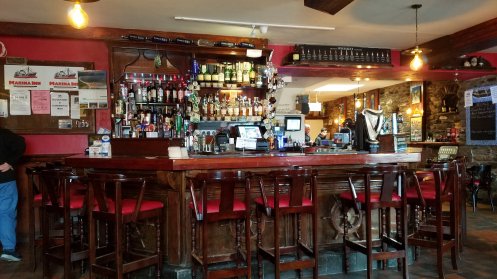
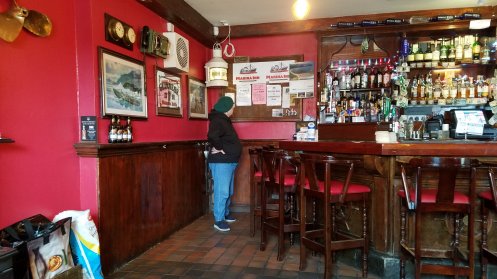
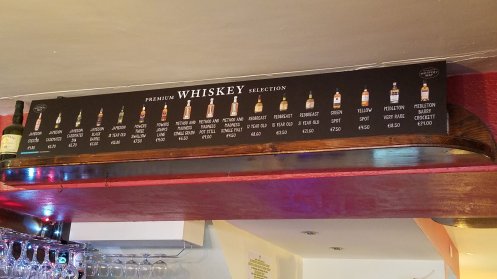
Back to the bus, where we are joined by Michael Moore (not related), who will guide us out to the peninsula tip and the Blasket Center. On the way, the bus stops at Cashel Murphy, a 3,000 year old house cluster and stone fort.
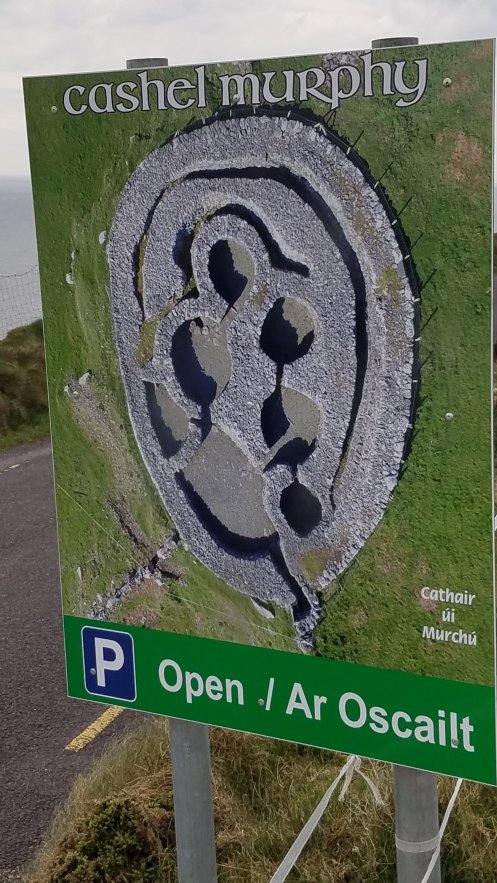
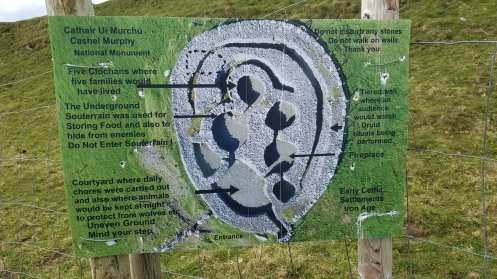

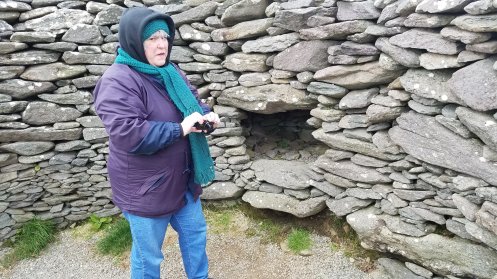
We are welcome to wander and even descend into the sous-terrain. This is a tunnel about 22 feet and turn left into a 15 foot circular room, no lights, take your own.


To get in, you step down, and back into the tunnel. We are told that the head family could use this to hide and to maintain an advantage if any raiders tried to follow them in. 7 tour members take the challenge.
On to the Blasket Islands Heritage Center. The Blaskets are a set of several islands, inhabited until 1953 by farmer and fishing families. Population declined due to emigration to the mainland and other countries, until the government evacuated the mosty elderly or disabled residents. The Center memorializes the history, life, and culture of the islands in murals sculpture and movies, and our local guide shepherds us around the Center.
The bus continues around the ring road at the west end of Dingle, and the guide points out where David Lean and company spent a long time building sets and filming Ryan’s Daughter in 1970. They were hoping to be hit by a good Atlantic storm for some of the scenes, but it didn’t happen, so they had to move those scenes to South Africa.
As we pass through the nearby village church, our guide challenges us to guess the age of a standing stone with a Maltese cross caved in the face. Turns out it’s a prop left over from the movie, so about 50 years old. Nobody could get a picture.
After three nights in Bantry, we depart at 10 for the next stay. First stop is Glengarriff, where we stopped on Friday. We had told the shop we would return on Sunday, so the folks who went to Garinish Island could take advantage of the shopping. Unfortunately, our leisurely departure fom Bantry wasn’t leisurely enough. We arrived at 10:30 with a 45 minute shopping halt, and the big Quill’s store doesn’t open on Sunday until 11, and they are leisurely about that. The other store was open, though, and they did good business. Next stop, Molly Gallivan’s Farm, a shop and heritage center. Molly was a 19th century farm widow with several children to feed. A road was constructed past her farm on the mountain road from Cobh to Bantry to Killarney for rich English hunting and holiday groups. Molly started a shop selling crafts with a tea room. Some of the tea was of a stronger sort, namely poitín (pronounced potcheen, emphasis on the first syllable). Along with the farm heritage talk and tour, there is a current demonstration of her still and distribution of a small sample of (properly taxed) similar wares. Kinda like moonshine you can buy in a liquor store in the Ozarks in a commemorative bottle.

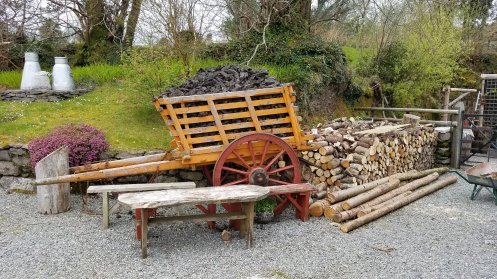
 This a is a horse drawn cart for hauling turf (peat fuel for cooking, distilling, and heating), dug, dried, and brought from the moors in summer for survival through winter.
 Then on to Kenmare for lunch and wandering.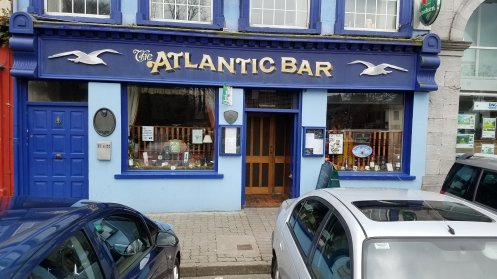
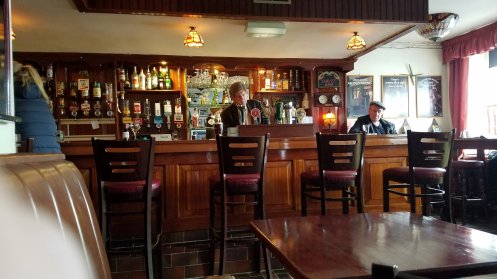 Shopping is involved, and there happens to be a Quill’s woolens and knitwear store hard by the bus parking place. Glengarriff’s loss is Kenmare’s gain.
 And onward to Killarney.
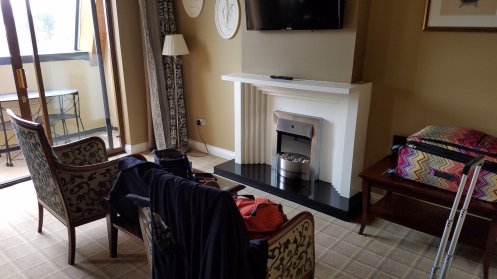

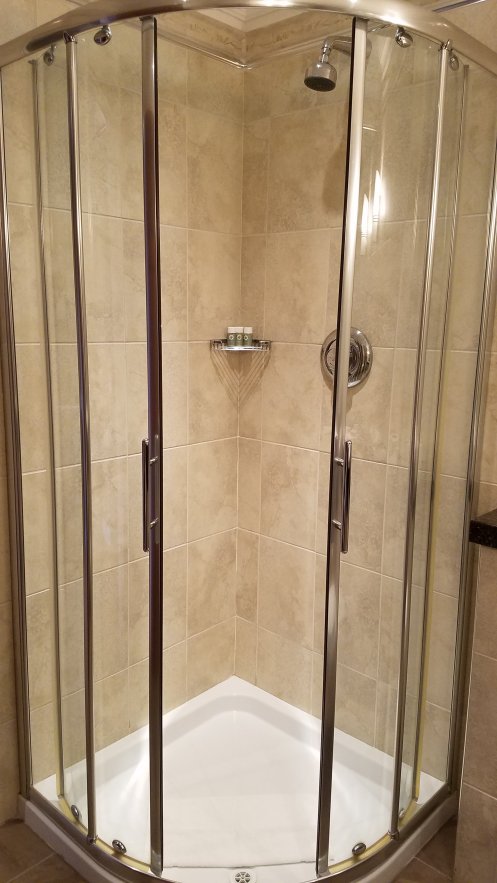 Our room at the Lake Hotel in Killarney.
Mizen Head. The name strikes terror in the hearts of those of us who have done this before.
Mizen (pronounced mizzen) Head is the farthest southwest point in Ireland, a granite promontory surrounded by granite shoals, and a hazard to navigation.
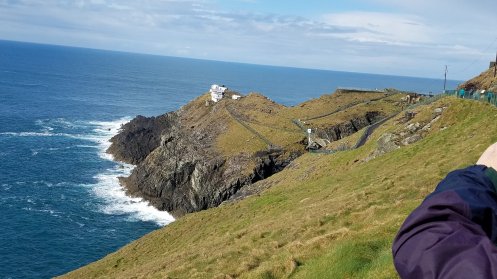
It was also Guglielmo Marconi’s station for early telegraphic communication with ships at sea in the north Atlantic to improve safety in navigation.
It features a signal light and is the site of the former Fastnet lighthouse tower built of shaped interlocking granite blocks that, when the light was turned into an automatic system, had to be disassembled layer by layer.
Getting out to the buildings is frequently hampered by high winds, sleet, snow, lashing rain, and chill.


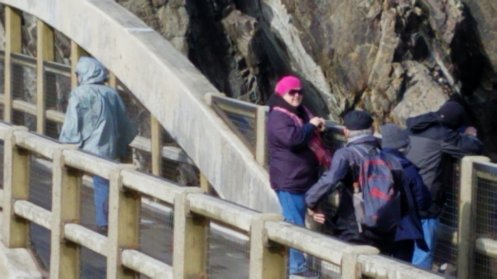
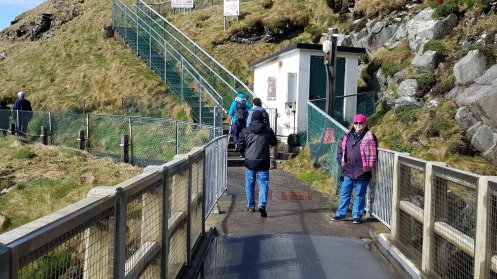
When we were here 8 years ago, we were driven back by wind, rain, and sleet. This time Paula made it across the bridge and even looked over into the gorge below.


She did turn back out of respect for her hips and knees. James pressed on, determined to achieve the farthest, safest point and redeem the earlier failure.


Did it. Weather was blustery, but moderate, no rain or sleet.
A picture of our tour leaders.
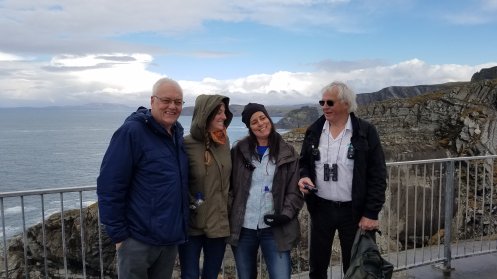
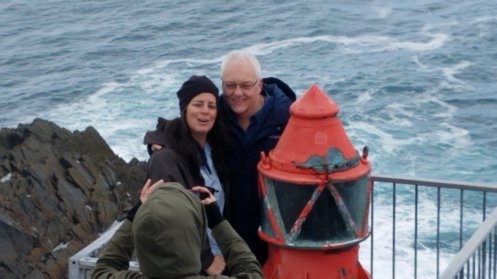
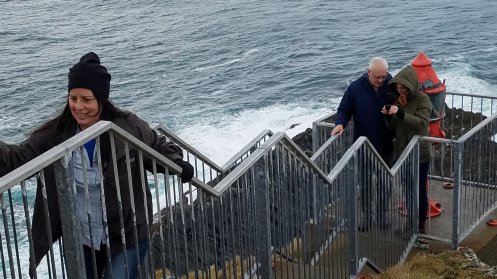
Lunch in the cafe, root vegetable soup and a BLT shared between us. Then back to the bus and to Bantry in time for a nap before placing some last minute side bets, James included, and seeking a viewing pub.
An exciting race, and while the syndicate broke even, few of the side bets paid off, and none of ours. Maybe next time.
Full Irish breakfast plus. Irish breakfast entails eggs, sausages, bacon rashers, black and white puddings, mushrooms, broiled tomatoes, and toast. At Bantry they add baked beans, which nudges it toward English breakfast.
The morning activity is a bus ride up to Glengarriff, and a short ferry ride over to Garinish Island. Because of its sheltered location, it possesses its own microclimate, enabling cultivation of tropical plants. Passed out of private ownership, it now features exotic plants and trees, as well as fanciful buildings, pavilions, a martello tower from Napoleonic wars, an estate house, walled garden, and a reflecting pool. No pictures now, cuz we didn’t go over. We’ve been there twice before.
Instead we and another couple spent some quality time perusing the goods at a couple of retail establishments before walking up the road to Casey’s Hotel to check in with the hotel host, Donal, whom we befriended years ago. He, however, was laid up suffering with a bad back, facing surgery, and unable to come down to the pub. So we treated ourselves to a pint and chatted with Owen, his youngest son running the hotel and pub. And met Owen’s wife and 8-week old child. Owen is just as accommodating as his father, even when Jeff inquired about a “local” beverage.
The group returned from the island, got on the bus with us, and were promised a return to these shops when we pass through Glengarriff on Sunday on our way to Killarney.
Afternoon involves a downtown flea and food market (burritos in a cardboard bowl, seated on the curb) and while many of the group then go for a tour of Bantry House, another group engages in research and consultation regarding odds on horses in the British Grand National annual steeplechase (think National Velvet).
A small syndicate picks a few horses and lays down modest bets at Paddy Power, a chain of bookies, and people place a few side bets. We only do this whenever we’re in Ireland for the spring tour, hardened gamblers that we are, and we involve an absent member of the Usual Suspects through the miracle of electronic communication.
The race will be on Saturday at 5:15 PM, so we’ll need to conclude Saturday activities in time to find a pub, a seat, a pint, and a screen. Not always easy in Ireland on race day.
9:30 and the bus pulls away from the Park Inn. First stop is Cobh, 2.25 hours away. Cobh, pronounced Cove, was originally named Cove by the British Navy, being a protected inlet harbor on the south coast of Ireland. It was officially named Queenstown up until 1921, after the Irish people succeeded in creating their own government, when the town was renamed Cove, but with an Irish spelling.
Queenstown/Cobh was the last port for the Titanic, where 2 first class, 7 second class and 129 third class emigrants joined the passengers from Southbampton and Cherbourg bound for the US.
In one of the quayside buildings, the former railway station, there is now a Cobh Heritage Centre, with narratives, photos, and artifacts about the trans-Atlantic sea traffic, including the Titanic, the Lusitania (sunk 35 miles south of Cobh), transportation to Botany Bay, and famine coffin ships.
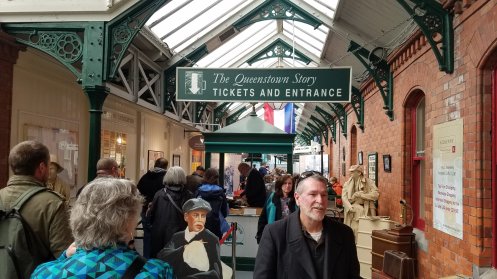
Outside the Centre is a statue of 15 year old Annie Moore and her two brothers. She was the first person to cross the threshhold of Ellis Island on January 1, 1892. There is a matching statue on Ellis Island, and the song Isle of Hope, Isle of Tears celebrates her and the hopes and dreams of all immigrants. The song takes some liberties, as Annie was 17, her brothers were 15 and 12, and Ellis Island was actually shut down in 1954.

Also outside the Centre across the road is a billboard promoting an exit for Ireland from the EU, dubbed Irexit. Probably not a strong movement, since Ireland benefits biggly from being in the EU.

Lunch at the Centre, then we board the bus for a couple of hours to Bantry. Stay is at the Maritime Hotel at dockside for three nights. Dinner at 6:30, then a Men of Worth concert, followed by a gathering of the usual suspects in the hotel pub.
Anther free day. Our possible jaunt to Bunratty is shrugged off due to 40 degrees and 20-30 mph winds, plus alternating rain, sun, and sleet.
The hotel seems to be experiencing some HVAC issues. Monday night was warm to the point of insomnia. Tuesday and Wednesday are contrarywise chilly in the rooms. I think it’s a plot to discourage people from staying in their rooms, instead driving them out to the economic benefit of the hotel and environs.
A few tour members are coming in today, some to the airport. James has driven to Dublin to pick up two ladies who had planned to come over by bus, and were having a grand day in Dublin until one fell and broke her upper arm. James drove over, met them at hospital, saw them through xray and splinting procedures and pain meds, loaded them into the car and drove them back in time for late dinner.
Another couple visited the Cliffs of Moher yesterday, and on their retreat from rain and sleet, she slipped on the sleet, bruised a kneecap and rolled over onto her shoulder, wrenching that. Donnie shuttled her into the doctor and xrays. Never let it be said that the guys and their wives don’t see you through stuff.
As for us, we napped, read, had lunch, napped some more, gathered with the group, did drinks and introductions, and did our first dinner as a group, with welcomes and various housekeeping information.
One of the features of these tours is that everyone submits short biographies which are collected and distributed three weeks or so before a tour. Everyone reads up, connects names with faces on the first evening, and goes back to their respective hotel rooms and reviews. Repeat for however many repeats it takes. Paula’s personal goal is to meet, have a meal with, and learn everyone’s full name by the end of the tour, take pictures to plug into the submitted electronic bios, and enter names on a spreadsheet that she keeps of all our tours and all tour members.
Thursday we’ll have bags in the hall by 8:30 and bus departs at 9:30. A very humane schedule and, I gotta say, a regular feature of these tours.
Next up, 3 nights in Bantry with day trips, then 5 nights in Killarney with day trips. And whiskey and biscuits (digestives) on the bus.
In Shannon for Tuesday. Free day, with plans to visit Bunratty Castle and Folk Park. Monday overnight, however, brings wind, sleet, and lashing rain at 3 AM, along with whistling and moaning at the hotel windows. This continues into the morning and afternoon, periods of rain and chill, punctuated by brief intervals of sunshine.
April brings the sweet spring showers, on and on for hours and hours.
The Castle offers an evening of “medieval banquet and entertainment”, but no availability, and the Folk Park is a collection of buildings from the past, but mostly outdoors exhibits. Not this trip, but perhaps a future trip
Instead we walk across to the airport to greet incoming tour group members, and otherwise hole up in the hotel, eating, drinking (but not to excess), socializing, playing cards and dice, napping, and blogging. Oh, and chicken curry, one of our favorites here, as long as we don’t lie down too soon afterwards.
We’ll spare you photos of the Ashling Hotel. It’s across the River Liffey from Heuston railway station where we entrain for the west, quite modern and very comfortable. What keeps us happy are the view and this, the St. James Gate beef and Guiness pie.
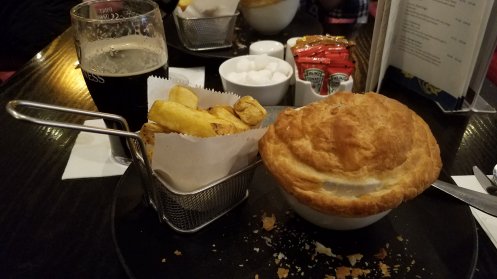
A puff pastry cover, Hereford beef in a mushroom and onion gravy. The chunky chips are good, but the pie is 2.5 cuts above all others in a myriad of Irish pubs, and we proselytize its virtues to anyone who will listen and even to some who don’t.
In the morning, we chow down at the hotel breakfast. Paula loves the pancake machine among other features. Press a button and watch the machine pour, cook, and disgorge tasty 5-inch pancakes. Topped with fruit compote–heaven!
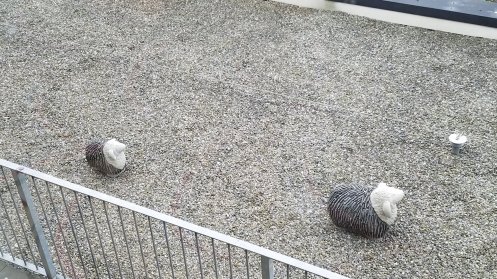
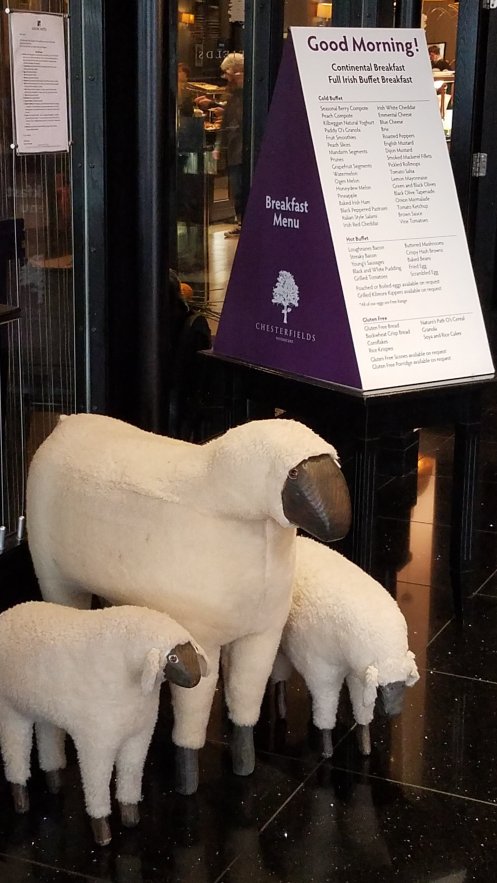
We’re seen on our way by some of the hotel’s sheep.

Heuston Station has seen some improvements, among them a new drink and dine joint: the Galway Hooker.
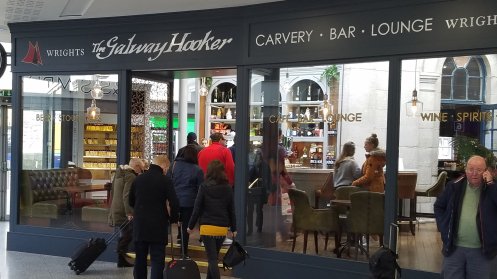
This has much to do with a type of fore-and-aft rigged sailing vessel and nothing to do with General Hooker.
We’ve done this cross-country route several times before. Big buffet breakfast at the Ashling Hotel, pack up, and board the 11 AM train at Heuston to Limerick Junction at 90-95 mph, change across the platform to a chunter up to Limerick Colbert Station, change to the 51X bus which drops us at the Shannon Airport, grab a luggage cart, and trundle over to the Park Inn. Check in and grab a quick nap, then back to the airport to greet other arriving tour group members and one of our leaders. The group gathers in the bar for an early supper, and winds down early in favor of sleep and jetlag recovery, with plenty of craic yet to come.
Our resting place for four nights.


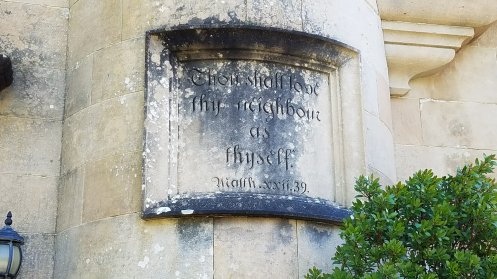

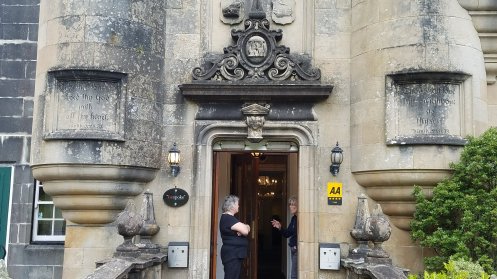

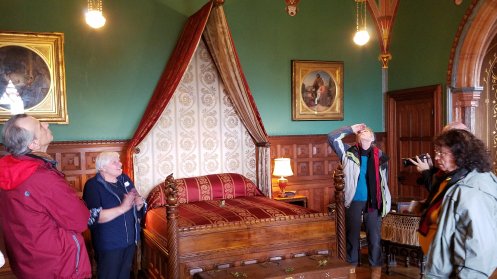
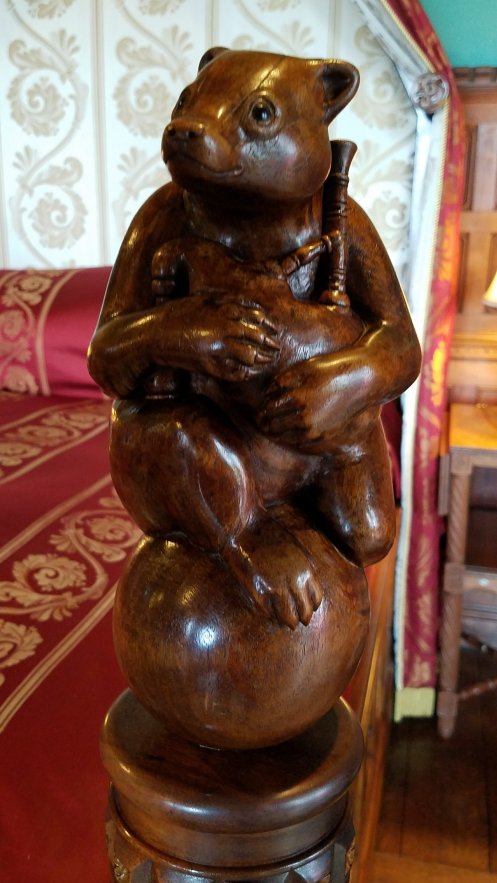

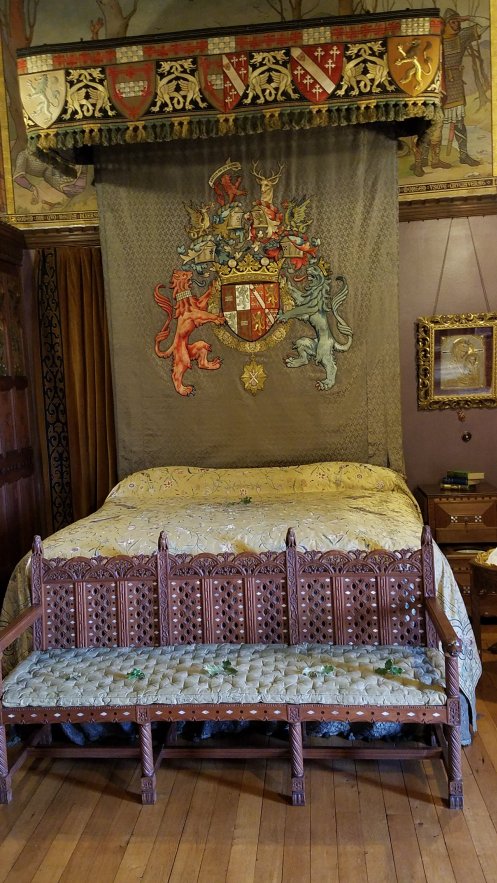
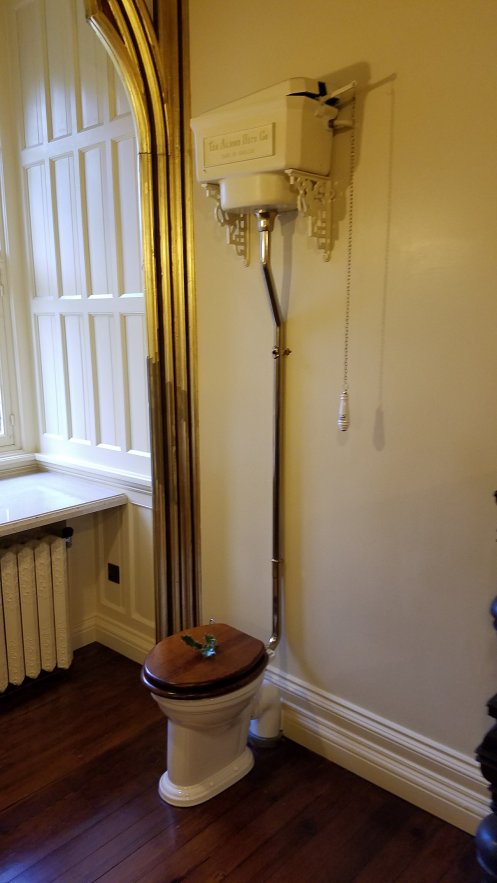

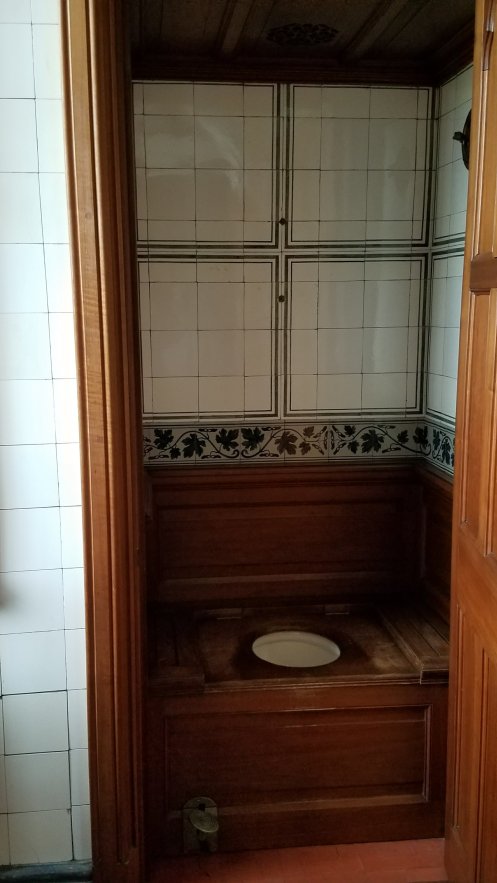

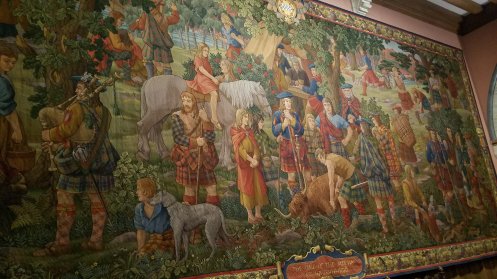
The central great hall entrance hall is colonaded, built with Italian and Sicilian marble and alabaster.

Two walls are covered by tapestries, 33 feet by 13.5 feet, made in Edinburgh, commissioned in 1912, completed in 1928 with a hiatus during World War I.

The vaulted ceiling rises 80 feet and is painted with the constellations in accurate position and scale.
The upper reaches of the hall are lit by 12 stained glass windows in calendar order, each depicting a sign of the zodiac.
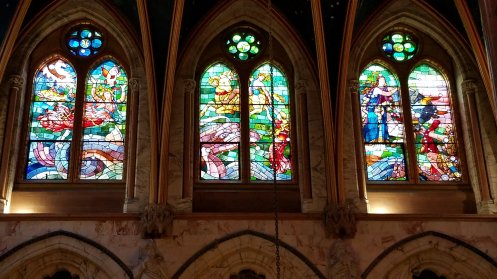
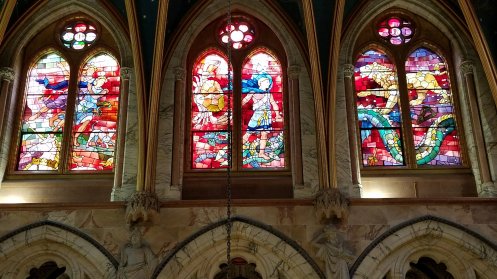


Stuarts were a Catholic family, and the chapel was in regular use.
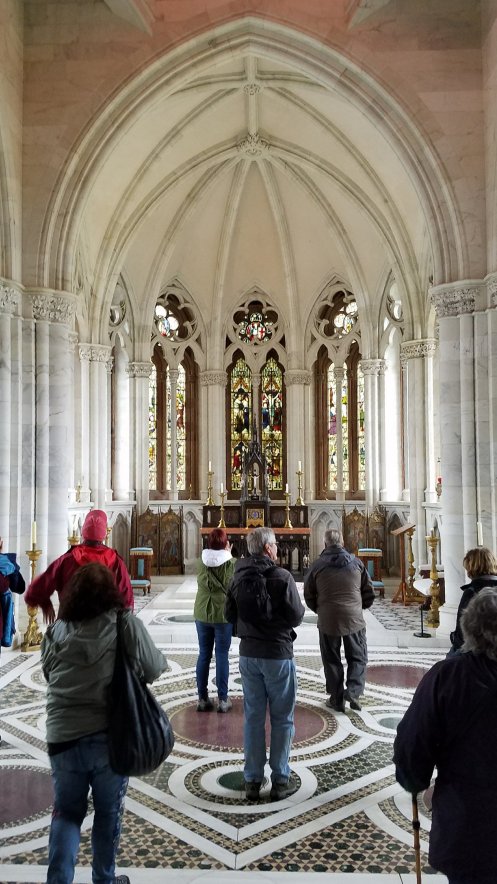

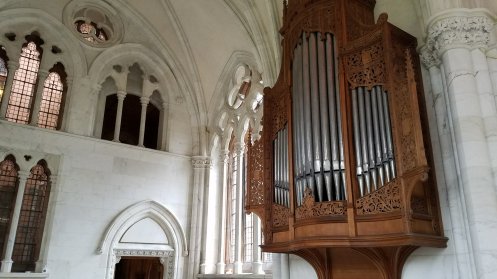
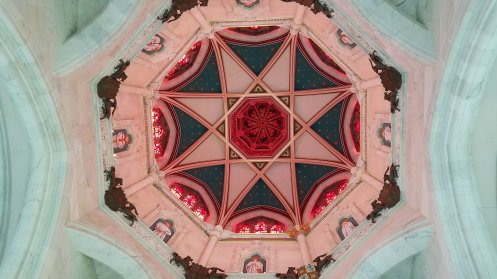
Looking up under the chapel’s central spire. On a cloudy day, the red glass suffuses the entire chapel, but our experience was muted by clouds and occasional rain.
Visit to a mansion that puts others to shame.


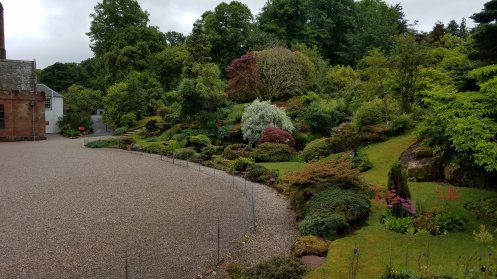
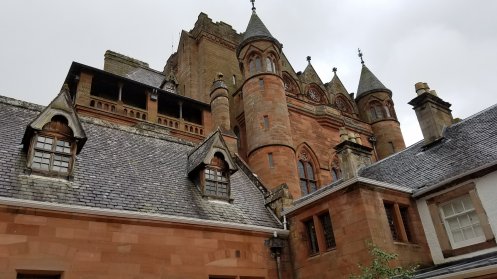
Home of the Stuarts of Bute who had a multi-generational talent for marrying well if not better, and serving the Crown, thereby graduating from Sheriff to Baronet to Earl to Marquess. Hearst Castle, Biltmore, and Newport mansions got nothin’ on this place.
A short distance from Glasgow are the first of several ferries that we will take in the next days. A shuttle train runs between Glasgow Central Station and the ferry terminal.


The ferry crosses between Wemyss Bay and Rothesay, carrying passengers, cars, buses, and heavy goods vehicles.
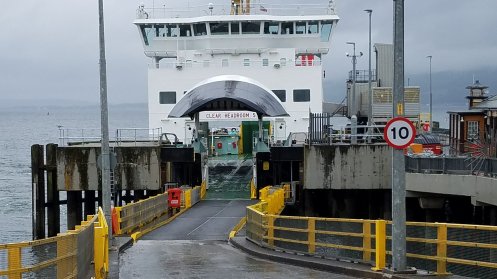

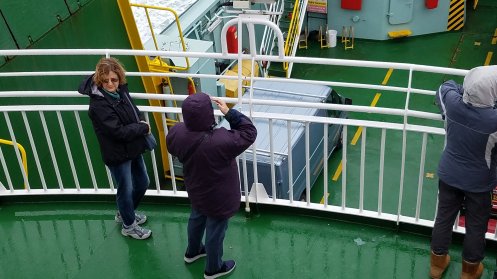
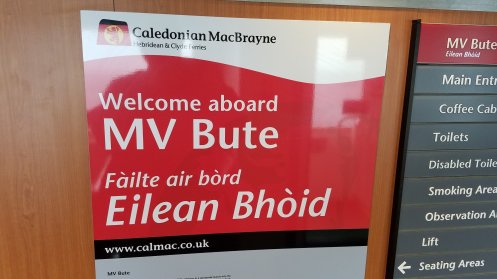
Signage is all in both English and Gaelic.
In the terminal waiting room, some art for sale.

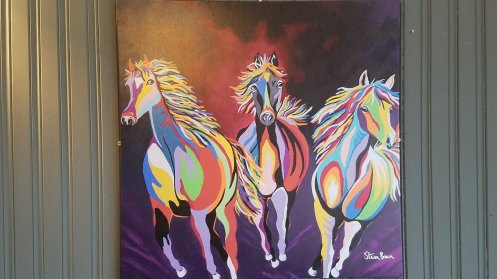
Ferry takes about 25-30 minutes. Then onward across the peninsula to the next ferry at Rhubadoch to Colintraive (5 mnute crossing) and then to Portavadie for a final crossing to Tarbert.
 travelntrouble